




Written by: Aaron Rovner, Founder, Saas Hero | Last updated: September 6, 2026
Key Takeaways
- Accounting tech sales cycles are long and complex, involving 6–10 decision-makers and 3–18 months, so long-term agency contracts create real risk when pipeline stalls.
- Generalist agencies often report on clicks and form fills instead of CRM pipeline, which leaves clients paying for underperformance without accountability.
- Month-to-month PPC shifts risk to the agency, requiring them to re-earn business every 30 days while delivering CRM-connected results.
- Realistic benchmarks show B2B SaaS CPL ranges from $50–$200 and SQL costs from $500–$2,000+, with true pipeline impact appearing after 90–180 days.
- For accounting tech marketers seeking flexible, results-focused PPC without long-term contracts, book a discovery call with SaaSHero to see how their outsourced growth team delivers CRM-driven outcomes.
Why Generalist Agencies Fail Accounting Tech (And Why They Need Long Contracts)
Generalist agencies fail accounting tech companies because their scope stops at the click. They manage the ad account and report on platform metrics, such as clicks, CTR, and cost per lead. The landing page belongs to the web team, the CRM to RevOps, and the conversion definitions to whoever configured Google Tag Manager three years ago. Nobody owns the chain from impression to CRM record, and the agency’s contract protects it from the consequences.
The typical agency report leads with form fills and cost per lead. For accounting tech, a form fill is the earliest and least informed proxy for revenue. Optimizing paid campaigns for MQL conversions forces algorithms to seek out low-intent users who download free files but have no budget. The fix is passing SQL and Opportunity milestones back to the ad accounts, yet most agencies lack the CRM integration to do this, and their contracts do not require them to learn.
Agencies push 12-month terms because they know results take time, and that point is valid. The contract also masks underperformance. As Lever Digital’s guide to choosing a B2B PPC agency puts it: “A confident agency does not need to lock you in.” Agencies that insist on 6-to-12-month minimums are “relying on contracts rather than results to retain clients.” For accounting tech, where the sales cycle itself runs 6 to 9 months, a long contract means paying for a full cycle of underperformance before earning the right to leave.
That reality is pushing more accounting tech marketers to look for flexible, performance-driven alternatives.
The Solution: What Month-To-Month PPC For Accounting Tech Actually Means
Month-to-month PPC for accounting tech is a flexible engagement model. A specialized agency manages paid search and paid social campaigns with no long-term commitment, typically billing on a flat retainer or a percentage of ad spend. The client owns all accounts, assets, and data. The agency earns the business monthly.
| Dimension | Month-To-Month | Long-Term Contract |
|---|---|---|
| Commitment | 30-day notice | 6–12 months minimum |
| Risk | Shifts to agency | Shifts to client |
| Flexibility | Test channels, pivot strategy | Contract amendment required |
| Agency Accountability | Must re-earn business monthly | Protected by termination penalties |
| Typical Pricing | Flat retainer or % of spend | Often % of spend with minimums |
Month-to-month can signal confidence rather than compromise. Month-to-month agencies like Orange MonkE and Flow New Patient Marketing report retention rates of 96% and 94%, respectively, with clients staying by choice rather than by clause. Leading month-to-month agencies use the model as a confidence signal, because results keep clients.
The caveat matters. Month-to-month only works when the agency stays genuinely accountable. A no-contract arrangement with an agency that reports on clicks instead of pipeline still wastes budget. The model must pair with CRM-connected reporting, transparent pricing, and real accounting tech expertise to deliver value.
That combination of accountability, transparent pricing, and niche expertise is exactly what the next sections benchmark, so you can evaluate any agency against real market data.
Pricing Benchmarks: What Month-To-Month PPC Costs For Accounting Tech
Industry data from 2026 sources converges on consistent ranges. WebFX’s 2026 marketing agency cost guide reports PPC management services at $1,500 to $10,000 per month. HawkSEM’s PPC management pricing guide averages flat-fee management at the same range. MarketinGO’s 2026 PPC pricing guide provides a more granular spend-to-fee table: accounts spending $5,000–$20,000 monthly on ads typically pay $1,500–$4,000 in management fees or 12–20% of spend; accounts at $20,000–$50,000 pay $3,000–$7,500 or 12–15%; and accounts above $50,000 pay $7,500–$15,000+.
| Segment | Monthly Ad Spend | Typical Management Fee | What’s Included |
|---|---|---|---|
| SMB Accounting Tech | $5k–$15k | $1,500–$5,000 or 15–20% of spend | Campaign management, basic reporting |
| Mid-Market Accounting Tech | $15k–$50k | $5,000–$10,000 or 10–15% of spend | Multi-channel, CRM integration, landing pages |
| Enterprise Accounting Tech | $50k+ | $10,000–$20,000 or 8–12% of spend | Full-funnel, dedicated strategist, advanced attribution |
The pricing model matters as much as the price. Percentage-of-spend pricing creates a structural conflict: when the agency’s revenue is a function of ad costs, every recommendation to increase budget carries an undisclosed interest, and every recommendation to cut waste is a pay cut the agency must volunteer for. Flat-fee pricing decouples the agency’s income from ad spend, so recommendations rely on evidence alone. A flat retainer indexed to total ad spend, not channel count, also removes per-channel pricing conflicts and turns channel mix into a practical testing question.
Performance Benchmarks: What Realistic Results Look Like For Accounting Tech
For accounting tech, the goal is qualified pipeline and closed revenue. A critical distinction applies here. The benchmarks below cover accounting technology, which means selling software to accountants, rather than accounting services firms marketing to individual clients. The audiences, keywords, and buying dynamics differ in fundamental ways.
Industry benchmarks from 2026 sources provide realistic ranges for accounting tech and adjacent B2B software categories:
- Cost Per Lead (CPL): For B2B SaaS and technology companies, Google Ads CPL typically ranges from $50 to $200 per marketing qualified lead. A campaign generating $50 leads that never close performs far worse than one generating $200 leads with a 30% close rate.
- Cost Per SQL: Industry data suggests SQL costs typically range from $500 to $2,000+ for B2B, but the exact figure varies by funnel stage, deal size, and industry. For example, B2B SaaS averages around $1,357, with ranges from $600–$2,500, while enterprise security can exceed $4,000. Most agencies report on CPL or CPA without closing the loop to actual revenue, which is why CRM integration is non-negotiable.
- Conversion Rates: B2B SaaS companies typically see Google Ads conversion rates of 2–5% for demo requests or free trial signups, with lower-funnel keywords converting at higher rates. A 2–5% conversion rate on a lead form is normal for accounting services on paid search; a 10%+ rate usually indicates low-quality traffic rather than exceptional performance.
- CPC Benchmarks: Technology industry Google Ads search campaigns averaged a CPA of $133.52, according to Uproas data cited in 2026 benchmark reports, reflecting longer B2B buying cycles and higher customer lifetime values. Microsoft Ads consistently prices 20–35% below Google for comparable queries, making it a frequently underused demand-capture channel.
Month-to-month still requires time to show results. Usable campaign data typically appears within 30–60 days, while real pipeline impact takes 90–180 days due to B2B buying cycles. A month-to-month agency should show leading indicators in the first 30 days, such as tracking setup, campaign structure, and early testing, and directional trends by day 90.
SaaSHero optimizes to CRM data, including qualified pipeline, lifecycle stage, and closed revenue. By pushing lifecycle stage events back into the ad platforms, the bidding algorithms learn from qualified outcomes rather than page events. This approach separates accounts that produce volume from accounts that produce pipeline. SaaSHero’s results reflect this method: TripMaster, a transit software company, added $504,758 in net new ARR over one year with a 650% return on ad spend. Playvox, a CX software company, achieved a 10x reduction in cost per lead alongside a 163% increase in lead volume.

To replicate outcomes like these, the right tech stack is non-negotiable.
The Tech Stack: What Your Month-To-Month PPC Partner Must Integrate
Effective PPC for accounting tech requires a specific stack. The non-negotiable tools are:
- CRM (Salesforce, HubSpot): The system of record for pipeline and revenue. The agency must integrate with it to optimize toward qualified outcomes.
- Marketing Automation (Marketo, Pardot, HubSpot): Owns lifecycle stages, scoring, and nurture. The definitions here determine what counts as qualified.
- Analytics (GA4): The behavioral layer for diagnosing post-click experience.
- Tag Management (Google Tag Manager): The home of conversion tracking and a common source of broken measurement.
- Ad Platforms (Google Ads, Microsoft Ads, LinkedIn): The execution layer. Microsoft Ads is frequently underused in B2B, offering the cost advantage mentioned in the benchmarks.
Without CRM integration, the agency optimizes toward form fills, and the platform faithfully finds more people who fill out forms. Optimizing for MQL conversions forces algorithms to seek low-intent users. The fix is passing SQL and Opportunity milestones back to the ad accounts, which requires the CRM connection to exist and the agency to know how to use it.
A practical qualifying question for any prospective month-to-month PPC agency is whether they optimize campaigns around CRM data or just form submissions. If the answer is form submissions, the algorithm is being trained to find the wrong people, and the client funds that mistake.
SaaSHero integrates with Salesforce, HubSpot, Marketo, and other leading CRMs. It pushes lifecycle stage events back into the ad platforms, so bidding learns from qualified pipeline rather than page events. Reporting runs in Looker Studio and HubSpot dashboards, which stay live, CRM-connected, and board-ready without manual reconciliation.

How To Evaluate A Month-To-Month PPC Agency: Red Flags Vs. Green Flags
When comparing no-contract PPC agencies for accounting tech, the following checklist separates agencies that earn retention from those that rely on contracts to enforce it.
| Red Flags | Green Flags |
|---|---|
| Insists on 6–12 month minimums | Offers month-to-month with 30-day notice |
| Reports on clicks, impressions, CTR | Reports on pipeline, CAC, cost per SQL |
| Cannot integrate with your CRM | Demonstrates CRM-connected attribution |
| No accounting tech experience | Shows case studies selling software to accountants |
| Percentage-of-spend pricing with no cap | Flat retainer decoupled from ad spend |
| Agency owns the ad accounts | Client owns all accounts and data |
| No landing page capability | Owns design, copy, and testing in-house |
| Vague about who manages the account | Names the senior strategist and their account load |
The single most important ownership rule is that ad accounts must live under the client’s own Business Manager, not the agency’s MCC, or the client loses all historical data upon cancellation. The client should own every account and dataset while the agency operates as an authorized user.
Ask prospective agencies for their voluntary retention rate, meaning how many clients stay when free to leave. As Flow New Patient Marketing’s CEO puts it: “A contract does not make us try harder. The fact that every client can fire us tomorrow is exactly why we keep a 94% retention rate.” A month-to-month agency with high voluntary retention demonstrates confidence in its results.
For accounting tech specifically, ask how the agency handles multi-stakeholder buying committees, compliance sensitivities, seasonality around tax deadlines, and sales cycles that run 6–9 months. A generalist agency will offer generic answers. A specialist will show campaign structures designed for these realities.
Common Mistakes To Avoid With Month-To-Month PPC
- Focusing On Clicks Instead Of Pipeline. The platform optimizes toward whatever it is rewarded for. That is why falling cost per click with flat pipeline is a warning sign, because the account is being trained to find the wrong people. To prevent this, demand CRM-connected reporting from week one.
- Ignoring Search Term Reports. Agencies skipping negative keyword hygiene burn 20–40% of client budgets on irrelevant traffic that will never convert. The search terms report is the tool that reveals this waste, since it shows what queries actually triggered ads and where budget is leaking. That is why you should require weekly search term review and disciplined negative keyword management.
- Using Generic Landing Pages. Traffic bought against a page nobody has changed in a year converts poorly and teaches the algorithm nothing. Headline copy is by far the most impactful lever for landing page conversion. Ensure the agency owns landing page design and testing.
- Skipping CRM Integration. Without CRM integration, the agency cannot distinguish a qualified opportunity from a newsletter signup. Make CRM integration a condition of engagement, and treat it as core scope rather than an add-on.
FAQ
What Is PPC in Accounting Tech?
PPC (pay-per-click) advertising for accounting tech refers to paid search and paid social campaigns designed to generate leads and pipeline for companies that sell software to accountants, including B2B SaaS, FinTech, and ERP products. This differs from PPC for accounting services firms, which markets accounting services to potential clients. The audiences, keywords, sales cycles, and compliance considerations are fundamentally different. Accounting tech buyers include finance leaders, compliance officers, operations managers, and technical evaluators, forming a multi-stakeholder committee that requires messaging tailored to each role. Accounting services PPC targets individuals or small businesses seeking a CPA or bookkeeper, and conflating the two produces campaigns that reach the wrong audience entirely.
Is Month-To-Month PPC Effective For Accounting Tech?
Month-to-month PPC can work very well for accounting tech when paired with the right agency. Month-to-month contracts shift the performance risk onto the agency, which must re-earn the client’s business every 30 days. As noted earlier, top month-to-month agencies retain over 90% of clients by choice, not contract. The model performs best when the agency combines flexibility with accounting tech expertise, CRM-driven optimization, and transparent reporting. Flexibility must sit alongside genuine accountability, or the engagement still produces weak outcomes.
How Much Does Month-To-Month PPC Management Cost For Accounting Tech?
Management fees typically range from $1,500 to $20,000+ per month depending on ad spend and complexity. For SMB accounting tech companies with $5k–$15k in monthly ad spend, fees run $1,500–$5,000 or 15–20% of spend. Mid-market companies with $15k–$50k in spend typically pay $5,000–$10,000 or 10–15%. Enterprise accounts with $50k+ in spend run $10,000–$20,000 or 8–12%. Flat-fee pricing is generally preferable to percentage-of-spend because it removes the agency’s structural incentive to inflate the budget. SaaSHero’s Growth Team starts at $4,000 per month, with the retainer indexed to total monthly ad spend under management, not channel count, so adding or removing channels does not change the fee.
What Results Can I Expect In The First 90 Days?
Month one focuses on setup, including tracking, CRM integrations, campaign architecture, audience construction, creative and landing page production, and the approval cycle on all of it. The first meaningful data arrives around day 30, which is the first point at which anything can be judged rather than assumed. Days 31–60 narrow the account, with underperformers paused, budget moved toward what works, and first landing page headline tests launched. By day 90, there is enough clean data to judge the channel on its economics and decide the next phase. Real pipeline impact typically takes 90–180 days due to B2B sales cycles, but a competent month-to-month agency shows leading indicators from week one, including evidence that the tracking, structure, and messaging thesis are sound.
How Do I Switch From My Current Agency?
The client should own everything, including ad accounts, conversion tracking, landing page files, creative, and dashboards. A proper transition takes 2–4 weeks and covers ownership verification, documentation, MCC linking, billing migration, and overlapping management. Short-term performance dips of 20–50% can occur in the first 30 days as campaigns are restructured, and this pattern is normal provided recovery begins by day 60. The most important step before switching is confirming that all accounts live under the client’s own Business Manager, not the outgoing agency’s MCC. If the agency owns the accounts, historical data may be lost upon departure. SaaSHero operates inside client accounts throughout the engagement, and all assets, files, and data remain with the client at all times, both during the engagement and after it.
Conclusion: The Case For Month-To-Month, Done Right
Month-to-month PPC for accounting tech is often preferable when the partner combines contract flexibility with genuine niche expertise. The model shifts risk where it belongs, keeps agencies accountable through earned retention rather than enforced contracts, and lets marketing leaders test a partnership without gambling a year of budget. CRM-driven optimization that reports in pipeline and revenue terms, transparent flat-fee pricing that supports channel diversification, and a team that understands how accountants buy software all work together to make the model deliver value.
The practical next steps are straightforward. Audit the current PPC account against the benchmarks in this guide. Define pipeline goals in CRM terms, such as cost per SQL, pipeline coverage, and CAC payback. Then evaluate agencies against the red flag and green flag checklist. If month-to-month flexibility, accounting tech expertise, and CRM-connected reporting sit at the top of the priority list, SaaSHero belongs on the shortlist.
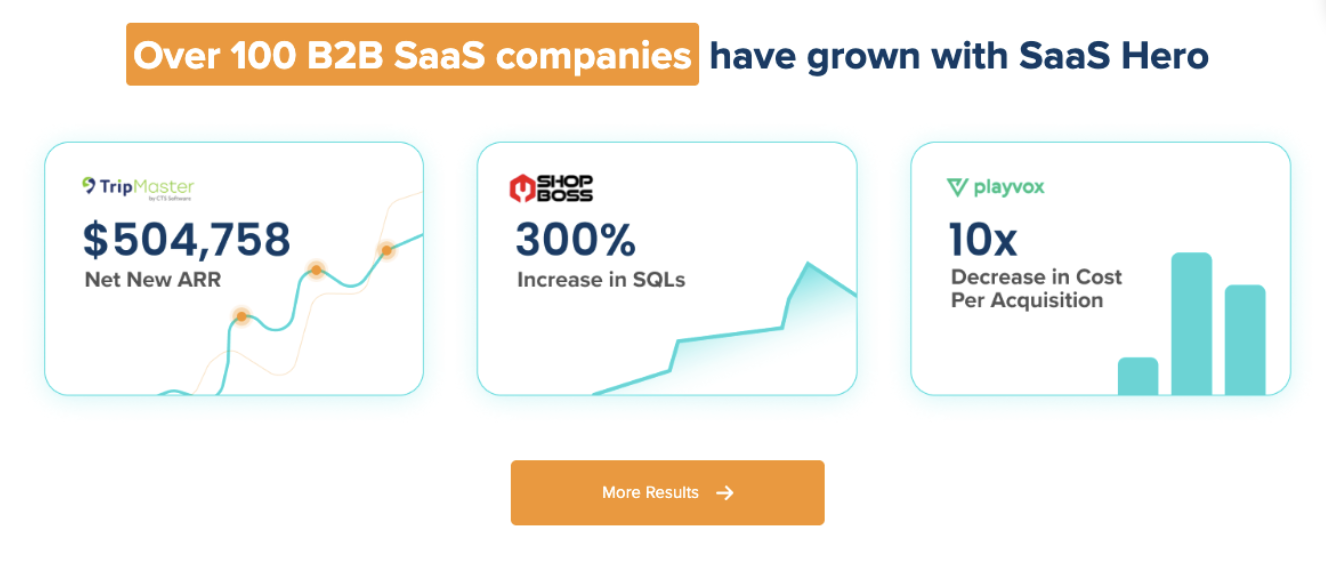
SaaSHero is the outsourced inbound growth team for B2B SaaS, founded in 2018, with over $60M in lifetime managed ad spend, 100+ B2B clients served, a Google Premier Partner designation (top 3% of agencies), and a G2 High Performer ranking of #20 out of approximately 6,000 agencies. The flat-fee, month-to-month model fits accounting tech companies that need CRM-driven results without long-term lock-in.
See how SaaSHero can help you scale qualified pipeline with month-to-month PPC.