




Written by: Aaron Rovner, Founder, Saas Hero | Last updated: September 7, 2026
Why This Retailtech Playbook Matters In 2026
Retail buyers move slowly, hide operational problems, and demand proof that a solution works across many stores. Your marketing has to match that reality. This playbook shows how to position narrowly, build proof fast, and turn pilots into pipeline over a focused 90-day sprint.
Why Retailtech Marketing Is Different From General B2B Marketing
Selling software to retailers is a distinct B2B motion. Retailers are cynical by default and often conceal their real operational problems, because admitting a logistics failure or a buying mistake creates internal risk. A founder can deliver a compelling deck and still walk away without a purchase order.
Retail organizations move cautiously. Decisions involve multiple stakeholders, long evaluation cycles, and careful risk assessment. Even objectively strong solutions must clear internal checks on integration complexity, ease of adoption, and proven track record. Key buyer titles like Chief Innovation Officer, Head of Digital Transformation, and VP of Store Operations need education and retail-specific credibility before they will champion a new vendor.
Retailers fund solutions to systemic problems across many stores. A problem in one store is an anomaly; the same problem across many stores is a systemic issue worth solving. Generic B2B playbooks ignore the pressures retailers care about most: margin compression, operational inefficiency, and fragmented customer experience. In-store inefficiencies now cost retailers $196.4 billion annually, or 6.4% of gross sales. The problem keeps growing because technology often arrives in the wrong sequence.
Your marketing must prove that your product delivers measurable outcomes in retail environments, not just in generic B2B settings.
Talk to SaaSHero about building a demand engine for risk-averse retail buyers.
The 90-Day Retailtech Marketing Playbook
Retail buyers need proof before they move. A 90-day sprint gives you a clear sequence: sharpen positioning, build proof assets, activate channels, then scale what creates pipeline.
Days 1–30: Positioning And Foundation
Positioning is the core job in the first 30 days. Every channel decision, every piece of content, and every dollar of ad spend depends on getting this right.
Define your ICP with surgical precision. Pick one retail vertical such as grocery, fashion, specialty, or home improvement. Then pick one painful, systemic problem within that vertical. A positioning statement built for everyone converts no one. Use a simple format: “We help [retail segment] reduce [specific operational problem] by [measurable outcome].”
Build a target account list mapped to specific decision-maker titles:
- Chief Innovation Officer (CINO)
- Head of Digital Transformation
- VP of Store Operations
- VP of Supply Chain
The average B2B sales cycle has expanded to 6.5 months in 2026, and buying groups now average 6.8 stakeholders per deal. Your account list should reflect the full buying committee, including champions, influencers, and approvers.
Set up your CRM and analytics infrastructure before any ads run. Measure pipeline from day one, not form fills or cost per click. Connect your ad platforms to your CRM so lifecycle stage events become the optimization signal.
Days 31–60: Content And Channels
With positioning locked, the next 30 days focus on building proof and activating channels that reach your target accounts.
Case studies are the most important asset in retailtech marketing. Turn pilot customers into evidence such as “reduced stockouts by 12%” or “increased online conversion by 20%.” Social proof reduces perceived risk, turning “Will this work?” into “This has worked before, so it might work for us too.” Even a small pilot can produce a strong case study when the ROI is clear and measurable.
Launch a content hub targeting high-intent queries like “retail inventory software ROI” or “how to reduce retail shrink.” Structure every page for AI search visibility. AI Overviews now reach 1.5 billion monthly users, and 79% of B2B buyers say AI search changed how they research vendors. Clear structure increases your odds of being cited.
Activate LinkedIn and ABM campaigns against your target account list. LinkedIn commands 41% of total B2B ad budgets and delivers 121% ROAS. That combination makes it the primary demand-creation channel for B2B. Run awareness campaigns first with problem-focused content that earns recognition. Ask for demos only after you build familiarity.
Register for industry events that your buyers already attend. NRF’s Big Show offers VC Startup Meetups, Innovators Showcase opportunities, and invite-only executive networking events including the Retail Digital and Marketing Executives Party and the Retail CIO Party. Apply for awards like the Retailtech Breakthrough Awards to build third-party credibility your sales team can reference.
Days 61–90: Scale And Refine What Works
By day 60, you should have enough data to make confident decisions. Double down on channels that produce real pipeline and qualified opportunities.
Cut what is not working without sentiment. If one channel represents more than 50% of your pipeline, you have a single point of failure. As you rebalance, use retargeting and nurture sequences to move warm prospects through the funnel. Retailers who engaged with awareness content but did not convert need solutions, case studies, and ROI frameworks instead of another cold ask.
Refine your landing pages continuously. Headline copy is the most powerful lever for conversion. Test your headline first. Then test your offer and your form structure. A higher conversion rate improves the economics of every keyword and audience feeding that page.
Track success with pipeline, CAC payback, and LTV:CAC. The median B2B SaaS company spends $2.00 to acquire $1.00 of new ARR, and CAC payback periods have lengthened 12.5% since 2022. CAC payback under 12 months is healthy. LTV:CAC of 3:1 is the minimum threshold most boards expect.
Targeting Retail Decision-Makers
Only about 5% of B2B buyers in a category are in-market in any given quarter. The remaining buyers will purchase later. Your nurture sequences should support that long horizon instead of chasing only this quarter.
Reach retail executives through a mix of LinkedIn, ABM, and personalized outreach. Speak directly to the pain that shows up in their weekly operations:
- Margin pressure from rising labor and supply chain costs
- Fragmented tech stacks that block clean data flow
- Customer experience gaps driven by stockouts and slow fulfillment
- AI investments that are not yet producing measurable ROI
A 2026 KPMG survey of 250 retail executives found that 52% of retailers spend $50 million or more annually on digital technology, yet only 48% of retail firms measure tech performance against actual business plans. That gap between investment and measured outcome is your opening. Position your solution as the bridge between spend and results.
Engaging all stakeholders such as CIO, Head of Digital, and Finance simultaneously through ABM shortens sales cycles by avoiding one-by-one approvals. Map the full decision-making unit before your first outreach touch.
Building Case Studies And Social Proof
Retailtech case studies should lead with hard numbers, for example “reduced stockouts by 12%,” “accelerated online order fulfillment by 40%,” or “decreased out-of-stock items by 30%.” Vague outcome language like “improved efficiency” or “enhanced visibility” does not move a risk-averse retail buyer.

The most effective case study format for both human readers and AI citation follows a consistent structure: the client’s challenge, the approach, and the measurable outcome. Build every case study to this template so AI search engines and your sales team can reference it easily.
Seventy-seven percent of B2B buyers check user reviews before purchasing. Seed your case studies across G2, Clutch, and TrustRadius. Fifty-four percent of SaaS buyers talk to an existing customer before purchasing. Make that conversation easy by building a formal customer reference program from your first five accounts.
See how SaaSHero turns pilot results into proof assets that generate pipeline.

Leveraging Industry Events And Awards
Events should function as a pipeline system. They deserve the same discipline you apply to any other demand-generation channel.
NRF’s Big Show is the highest-leverage event in the retailtech calendar. The VC Startup Meetups match innovative startups with investors for one-on-one meetings. The Innovators Showcase puts your product in front of retail executives who are actively looking for solutions. Invite-only events like the CIO Party and the Digital and Marketing Executives Party provide direct access to the decision-makers your ABM campaigns target.
Treat every event as a three-phase system. Allocate roughly 40% of effort to pre-event targeting, 20% to live engagement, and 40% to post-event nurturing. Begin pre-event outreach four weeks before the show. Send LinkedIn connection requests, personalized emails, and calendar invites to Tier 1 accounts before the floor opens.
A badge scan rarely equals a qualified opportunity. Measure pipeline generated instead of leads collected. End every conversation with a confirmed pain point, a specific follow-up action, and a CRM tag that links the contact to a campaign and a tier.
Content And SEO Strategy For Retailtech
Focus your content on high-intent, long-tail queries that map directly to retail operational pain, such as “retail inventory software ROI,” “how to reduce retail shrink,” or “omnichannel fulfillment software comparison.” These terms have lower volume than broad head terms but attract buyers who are already defining a problem and belong to the in-market minority mentioned earlier.
Build comparison pages, alternative pages, and outcome-focused guides. In 77% of deals, the vendor on the initial shortlist wins, and shortlists increasingly form through AI search before a vendor conversation. Structure every page with clear H2 and H3 headings, Q&A blocks, and data points so AI Overviews can cite your content directly.
For deeper guidance on channel-level execution and analytics, explore SaaSHero’s resources on Retailtech Marketing Trends and Retailtech Marketing Analytics.
Measuring Success: ROI And Pipeline
Retailtech marketing should be measured on pipeline and revenue. The metrics that matter are clear and tied to payback.
- CAC payback period: Under 12 months is healthy for B2B SaaS
- LTV:CAC ratio: 3:1 is the minimum; 4:1 to 7:1 is where profitable companies operate
- Pipeline coverage: How much qualified pipeline exists relative to your sales target
- Cost per SQL: Cost per sales-qualified lead by channel, not cost per raw lead
CRM-connected attribution is essential. Last-click attribution systematically defunds demand-creation channels by crediting the branded search that happens after the buyer feels convinced. Multi-touch attribution connected to your CRM reflects a six-month retail sales cycle with a seven-person buying committee more accurately.
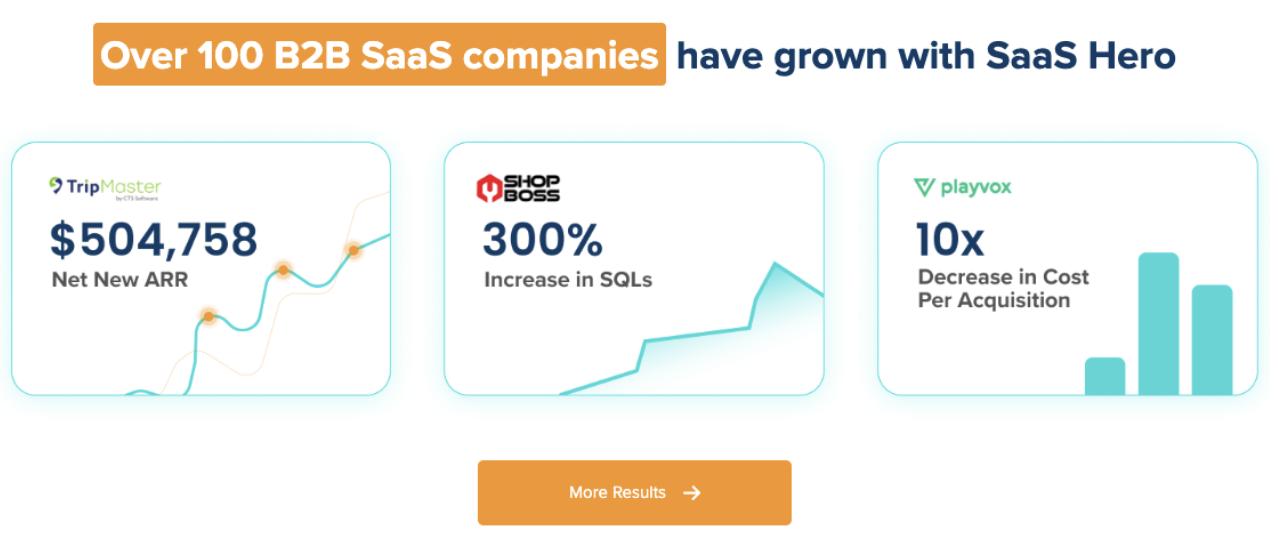
Many retailtech startups at this stage partner with an outsourced growth team to own the inbound acquisition engine. SaaSHero serves as the outsourced inbound growth team for B2B companies, with one team owning strategy and execution across paid media, creative, landing pages, and reporting. The team optimizes against CRM revenue data rather than form-fill counts. With over $60M in ad spend managed and more than 100 B2B companies served, SaaSHero owns the chain from impression to CRM record so you can focus on your product.
Conclusion: Launch Your 90-Day Retailtech Sprint
Retailtech startups that win in 2026 will position narrowly, prove ROI early, and execute a sequenced 90-day plan with discipline. Start with positioning and a pilot case study. Activate LinkedIn and paid search against a tightly defined ICP. Treat events as pipeline systems and measure everything against CRM outcomes.
The playbook is clear. Execution often stalls because generic B2B marketing agencies lack retail expertise, and building that expertise in-house takes time that most startups do not have.
Get SaaSHero to build and own your retailtech demand engine end to end.
Frequently Asked Questions
What Makes Retailtech Marketing Harder Than Standard B2B SaaS Marketing?
Retail buyers operate under constraints that most B2B SaaS playbooks ignore. They are risk-averse by design because a failed technology rollout can cost millions in lost sales, operational disruption, and political capital. They evaluate vendors through a multi-stakeholder committee that often includes the CIO for technical validation, the Head of Digital for business impact, and Procurement for final sign-off. They also hide their real problems, since admitting a logistics failure or a buying mistake creates internal exposure. Successful retailtech marketing leads with systemic, cross-functional pain such as margin pressure, stockouts, and fragmented data. It also builds social proof that makes adoption feel safer than maintaining the status quo.
Which Channels Should A Retailtech Startup Prioritize In Its First 90 Days?
Channel sequencing matters as much as channel selection. In the first 30 days, focus on positioning and ICP definition because no channel performs well without a sharp, outcome-led message. In days 31 to 60, use paid search to capture in-market demand and LinkedIn ABM to build awareness with buyers who are not yet evaluating solutions. Launch case studies and high-intent content in parallel to support both channels. Plan events like NRF as pipeline systems with pre-event outreach starting four weeks before the show. In days 61 to 90, double down on channels that produce qualified pipeline and cut those that do not. Use retargeting and nurture sequences to move warm prospects through the long retail procurement cycle.
How Should Retailtech Startups Measure Marketing ROI?
Retailtech startups should focus on pipeline and revenue metrics. Cost per lead and form-fill volume often mislead because ad platforms then optimize for the cheapest conversions instead of senior retail buyers. Track CAC payback period, LTV:CAC ratio, cost per sales-qualified lead by channel, and pipeline coverage against your sales target. Connect your ad platforms to your CRM so lifecycle stage events drive optimization. This requires building measurement infrastructure before campaigns launch, not after the first quarter of spend.
How Do You Build Credibility With Retail Buyers Who Have Never Heard Of Your Company?
Credibility in retailtech comes from social proof, industry presence, and consistent thought leadership. Case studies with hard, retail-specific metrics such as “reduced out-of-stocks by 30%” carry more weight than product descriptions. Third-party validation from awards programs, analyst mentions, and review platforms like G2 and Gartner Peer Insights reduces perceived risk through external endorsement. Presence at industry events, particularly NRF, builds recognition over time. Founder-led LinkedIn content that speaks to retail operational pain establishes thought leadership that makes decision-makers more receptive to outreach.
When Should A Retailtech Startup Consider Outsourcing Its Marketing Execution?
Many retailtech startups reach a stage where a founder or small team is juggling paid media, creative, landing pages, attribution, and content without deep specialization in each area. Outsourcing makes sense when marketing activity produces leads but not pipeline, when reporting cannot show whether spend creates qualified opportunities, or when the team spends more time managing vendors than executing strategy. An outsourced growth team like SaaSHero fits a B2B company with product-market fit, existing paid acquisition, and a marketing leader who needs specialists to own paid search, paid social, landing pages, and CRM-connected attribution. The right partner optimizes against CRM revenue data and leads strategy instead of waiting for test instructions.