




Written by: Aaron Rovner, Founder, Saas Hero | Last updated: September 4, 2026
Executive Summary: The Four Pillars of Modern Campaign Management
- Revenue-first attribution ties every ad dollar to pipeline and CAC payback, not clicks or form fills.
- CRM integration via offline conversion tracking (GCLID, Data Manager API) teaches bidding algorithms which clicks produced SQLs and closed-won deals.
- Automated QA catches tracking failures, budget pacing anomalies, and configuration errors before they corrupt spend.
- Multi-channel orchestration aligns messaging and budgets across search, social, and programmatic against strict ICP data.
These four pillars form the framework for the rest of this guide and define what effective SaaS adtech campaign management looks like in 2026.
Key terms used throughout this guide:
- Adtech: advertising technology platforms and tools used to plan, buy, and measure digital media
- DSP (demand-side platform): software that enables automated, programmatic buying of digital ad inventory across multiple exchanges
- Programmatic: automated, auction-based buying of digital advertising inventory in real time
- Revenue-first attribution: a measurement approach that connects ad spend to CRM outcomes—pipeline, SQLs, closed revenue—rather than platform-reported conversion counts
- Primary vs. secondary conversions: primary conversions drive Smart Bidding optimization; secondary conversions are tracked for reporting only and do not influence bids
- CAC payback: the number of months required to recover the cost of acquiring a customer through gross margin
- Multi-touch attribution: a model that distributes credit across all touchpoints in a buyer’s journey rather than assigning it to the last click
How the B2B SaaS AdTech Landscape Works in 2026
The B2B SaaS adtech ecosystem involves marketing leaders, RevOps, sales teams, and the platforms themselves. Core channels include Google Ads, LinkedIn, Meta, Microsoft Ads, and programmatic DSPs such as The Trade Desk and DV360. The tooling layer spans attribution engines, QA agents, and CRM connectors.
Platform automation has shifted the competitive differentiator from lever-pulling to data quality. An optimization algorithm finds more of whatever it receives as a reward signal. When it targets a form fill, it finds the people most likely to fill in forms, such as students, competitors, and job seekers, while reporting a falling cost per conversion. The shift from last-click to multi-touch attribution reflects longer B2B sales cycles and the need to credit demand-creation channels accurately.
The gap between legacy and modern approaches is structural. Legacy setups optimize to form fills and manage channels in silos, with each vendor accountable only for its own platform. Modern setups feed CRM data such as qualified opportunities, lifecycle stage events, and closed revenue back into the bidding algorithms. They also run all channels under one shared measurement layer.
On benchmarks: the 2026 Aleph and Benchmarkit SaaS and AI Performance Benchmarks, based on full-year 2025 actuals from 342 B2B SaaS companies, puts the overall median CAC payback period at 16 months. Sub-$5K ACV deals show an 11-month median, while $50K–$100K ACV deals run to 22 months. These figures vary significantly by deal size, so benchmarks must match your ACV band.
Key Strategic Decisions and Trade-offs
Four decisions shape the architecture of any SaaS adtech campaign management program.
Decision 1: In-House vs. Agency vs. Hybrid. In-house teams provide control but rarely cover all five required disciplines at specialist depth: paid search, paid social, creative, landing pages, and attribution. Agencies may be siloed by channel scope, stopping at the ad account and leaving the landing page and CRM connection to the client. The strongest configuration uses an internal owner who sets goals and holds the pipeline number, with a specialist team owning strategy and execution across the full chain. Once ownership is clear, the next decision is which channels deserve your budget.

Decision 2: Channel Prioritization. Search captures existing demand, while social creates demand that does not yet exist. LinkedIn functions as a demand-creation channel rather than a demand-capture channel, so judging it on demo requests from cold audiences guarantees failure. The Trade Desk and DV360 offer programmatic reach but require different operational maturity and minimum spend commitments. DV360 typically requires $50K+ in monthly minimum spend. After channel selection, the next decision is how conversions are tracked and valued.
Decision 3: Conversion Tracking Architecture. Primary conversion events determine what bidding algorithms optimize toward. Offline conversion import from CRM is the single highest-impact technical change available to most B2B SaaS advertisers. Implementing offline conversion tracking typically improves SQL volume by 30–50% at the same ad spend level. This result is based on data from more than 300 B2B SaaS accounts. With conversion architecture in place, the final decision is how to assign credit across touchpoints.
Decision 4: Attribution Model Selection. Last-click understates every upper-funnel channel in long B2B cycles. In a six-to-nine-month sales cycle, last-click credits the branded search that happened after the decision was made. Multi-touch attribution requires CRM data integration to be meaningful and to reflect the true contribution of demand-creation channels.
Step-by-Step Implementation: The Revenue-First Playbook
The following five steps outline the operational sequence for revenue-first campaign management, based on documented best practices across B2B SaaS accounts.
Step 1: Define Revenue Goals and KPIs
Revenue goals must align with unit economics and shared definitions across teams. Start by setting clear financial targets, then define what counts as progress in the funnel.
- Set CAC payback targets: under 12 months is considered strong for CAC payback period, but the evidence does not specify ranges for acceptable or warning levels.
- Establish LTV:CAC targets: a 3:1 LTV:CAC ratio is generally considered healthy for SaaS, but the evidence does not specify other ranges.
- Align on SQL, opportunity, and closed-won definitions across marketing, sales, and RevOps before changing any platform settings.
Step 2: Set Up Conversion Tracking with CRM Integration
- Capture GCLID at form submission via hidden field or native HubSpot integration.
- Store GCLID on the CRM contact record and propagate it through Lead → Contact → Opportunity (Salesforce Flows are required; Lead field mapping does not cover Opportunities).
- Connect Google Ads Data Manager to HubSpot or Salesforce (native connectors sync every 6 hours for HubSpot).
- Enable Enhanced Conversions for Leads with hashed email as a supplementary match key, because GCLID expires after 90 days, and the median enterprise B2B SaaS sales cycle exceeds this window.
- Google deprecated the UploadClickConversions API on June 15, 2026; all new integrations must use the Data Manager API.
Step 3: Establish Primary vs. Secondary Conversions
- Primary conversions drive Smart Bidding; secondary conversions are observation-only.
- Set primary conversions to qualified opportunities or SQLs instead of form fills.
- Assign conversion values using historical close rate multiplied by ACV: a demo request that closes 22% of the time at $6,000 ACV is worth $1,320, not $1.
- Demote newsletter signups, content downloads, and low-commitment form completions to secondary status.
- Meet the minimum data threshold: 30 conversions per month for Target CPA, 50 for Target ROAS. If closed-won volume is insufficient, use SQL or opportunity-created as primary with fractional values.
Step 4: Implement Automated QA and Pacing Alerts
- Set up pre-launch gates such as UTM validation, pixel presence, landing page HTTP status checks, and geo targeting verification.
- Configure post-launch monitors: first 60–180 minutes check delivery distribution and pixel events; run daily checks for the first week.
- Manual QA causes 23–35% of avoidable launch errors; automated workflows reduce launch-day errors by 60–80%.
- Monitor offline conversion pipeline health by comparing Google Ads offline conversion volume to CRM deal volume weekly; divergence above 20% indicates a break.
- Set 90-day calendar reminders for API token expiration, because many OAuth tokens expire in 60–90 days without auto-refresh.
Step 5: Orchestrate Multi-Channel Campaigns
- Align messaging and budgets across search, social, and programmatic using a three-stage demand creation framework: awareness (problem-focused, engagement-optimized), consideration (solution-focused, traffic-optimized), and conversion (warm audiences only, pipeline-optimized).
- Structure campaigns by intent tier (Brand, Competitor, Product, Problem) rather than match type.
- Protect 15–25% of budget for problem-stage campaigns measured over 90–120 day windows.
- Refresh PMax audience signals every 30–45 days and rotate creative every 4–6 weeks.
Tool Categories and Selection Criteria
The table below summarizes the main adtech tool categories, what each does, and how they are typically priced. Use it as a starting point for building your stack.
| Tool Category | Primary Function | Key Examples | Pricing Model |
|---|---|---|---|
| Programmatic DSPs | Automated inventory buying across display, video, CTV | The Trade Desk, DV360 | Custom enterprise pricing; DV360 typically requires $50K+ monthly minimum spend |
| Paid Social Platforms | Demand creation across professional and consumer networks | LinkedIn, Meta | Self-serve auction pricing; LinkedIn premium for B2B audience data |
| Attribution Engines | Map top-of-funnel engagement to closed-won revenue | Rockerbox, Northbeam, Dreamdata | $750–$1,500+/month subscription tiers |
| QA and Pacing Agents | Automated error detection, budget pacing, anomaly alerts | Atomic Ads, Optmyzr, Adalysis | Monthly SaaS fees; varies by channel coverage |
Selection criteria for adtech campaign management tools:
- Ease of CRM integration (native connectors vs. custom API work)
- Support for offline conversion tracking and Data Manager API compatibility
- Automation capabilities for QA and pacing
- Fit with B2B sales cycles (90+ day windows, mid-funnel milestone tracking)
Common Pitfalls and How to Avoid Them
Optimizing to form fills. Form fills are the earliest and least informed proxy for revenue. When Smart Bidding optimizes to form fills, it finds the cheapest people to convert, such as students, job seekers, and competitors, while reporting a falling cost per conversion. To fix this, use primary conversions that reflect qualified pipeline, such as SQL or opportunity-created, and push lifecycle stage events back to ad platforms via offline conversion import.
Ignoring CRM data. Without offline conversion tracking, the click is recorded in Google Ads and the opportunity in Salesforce months later, with nothing joining them. The fix is to implement GCLID capture and propagation through the entire CRM record lifecycle. One audit of a B2B logistics SaaS spending €18,000/month found that 43 closed-won deals worth €411,000 in a single quarter produced only nine reported conversions in Google Ads because the GCLID was lost during Lead-to-Opportunity conversion in Salesforce.
Siloed channels. Google often receives credit for capturing demand that LinkedIn created, while LinkedIn gets judged on last-click demo requests and then labeled a failure. The fix is to run channels under one team with one measurement layer.
Lack of QA. Offline conversion pipelines break silently when GCLID capture stops after form updates, CRM field mapping breaks when lifecycle stages are renamed, or API tokens expire. The fix is to implement automated QA with weekly volume comparisons and 90-day token expiration checks.
Last-click attribution. In a 6–9 month B2B cycle, last-click credits the branded search that happened after the decision was made. The fix is to use multi-touch attribution with CRM-connected data.
Not testing landing pages. Headline copy is the most impactful lever for landing page conversion. The fix is to run continuous A/B tests on headlines and offers before scaling media spend.
Schedule a free audit to see which of these pitfalls are active in your current account.
Why SaaSHero Is a Complete Partner for AdTech Campaign Management
The pitfalls above share a common cause: fragmented ownership across platforms, landing pages, and CRM. SaaSHero was built to close these gaps by owning the full chain from impression to CRM record.

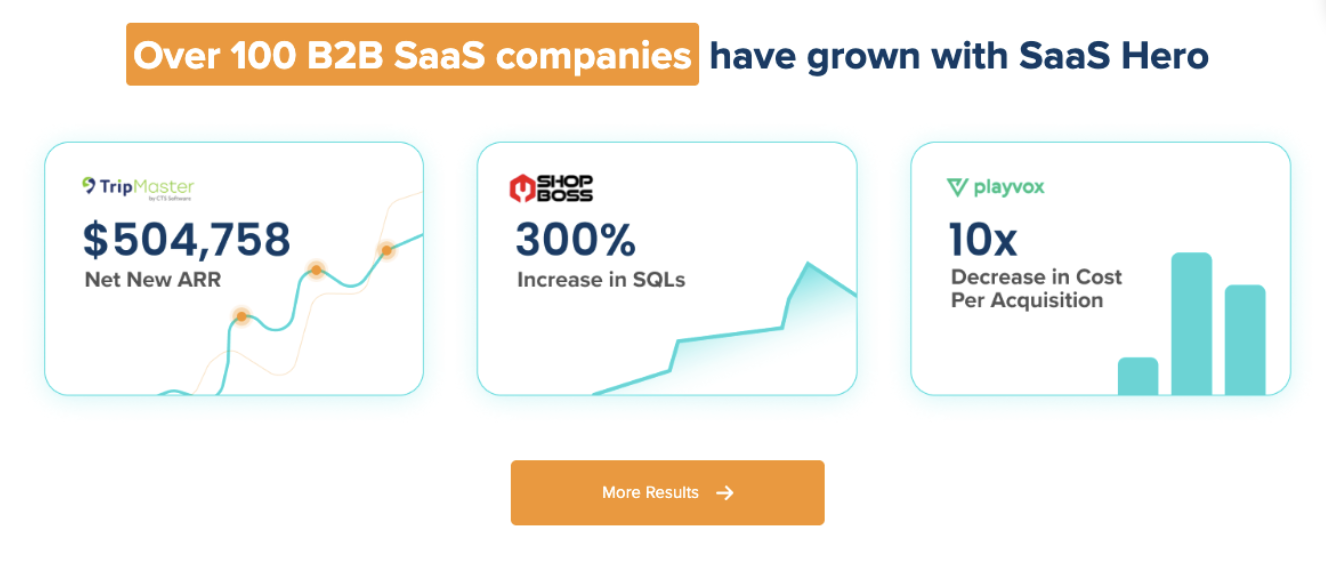
SaaSHero is the outsourced inbound growth team for B2B companies, with one team owning strategy and execution across paid media, creative, landing pages, and reporting. All work is optimized against CRM revenue data rather than form-fill counts. Founded in 2018, SaaSHero has managed over $60M in lifetime ad spend across more than 100 B2B companies, with a current team of approximately 20 full-time specialists including in-house designers and copywriters. All work is done in-house.
The operational complexity described in this guide, including conversion tracking architecture, CRM integration, automated QA, and multi-channel orchestration, requires one party to own the entire chain from impression to CRM record. Scope gaps between the ad account, landing page, and attribution layer are where performance is lost, and they arise from structure rather than individual vendor performance.

SaaSHero’s key differentiators:
- One team owns the entire chain from impression to CRM record, so no scope gaps appear between ad account, landing page, and attribution.
- Flat retainer based on total ad spend, not per channel, so channel mix decisions carry no fee consequence.
- In-house creative team, with designers and copywriters employed full-time.
- $60M+ lifetime ad spend managed, 100+ B2B companies served, 20 full-time specialists.
- Google Premier Partner (top 3% of agencies) and G2 High Performer ranked #20 of approximately 6,000 agencies.
- Optimization against CRM outcomes such as qualified pipeline, lifecycle stage, and closed revenue rather than conversion counts.
Get a free audit of your campaign management setup against the framework outlined above.
Frequently Asked Questions
What is SaaS adtech campaign management?
SaaS adtech campaign management is the process of planning, executing, and optimizing paid media campaigns across adtech platforms such as DSPs, paid social, and search. The goal is to drive measurable pipeline and revenue for B2B software companies. It involves conversion tracking architecture, CRM integration, budget pacing, and continuous QA so every advertising dollar ties to business outcomes rather than vanity metrics. In 2026, this discipline centers on feeding bidding algorithms revenue-grade signals from the CRM rather than platform-reported form fills.
How do I sync my CRM with ad platforms for offline conversion tracking?
For HubSpot, enable the native Google Ads integration in Settings → Tracking and Analytics → Ads. HubSpot automatically captures the GCLID on form submissions and stores it in the Google Ad Click ID contact property. Create conversion actions in Google Ads for each CRM stage such as SQL, Opportunity, and Closed-Won, then configure the native automatic import to push lifecycle stage transitions back to Google Ads with the GCLID and deal value. Enable Enhanced Conversions for Leads with hashed email as a supplementary signal to catch attribution where the GCLID has expired.
For Salesforce, create a custom GCLID text field on the Lead, Contact, and Opportunity objects. Build a Salesforce Flow to copy the GCLID from Lead to Contact to Opportunity as the record progresses, because Lead field mapping does not cover Opportunities directly. Connect Salesforce to Google Ads Data Manager and map Opportunity Stage values to Google Ads conversion actions. Use a dedicated integration service account so the sync survives employee turnover. Use the Data Manager API for new integrations, because the legacy UploadClickConversions API is deprecated.
How do I avoid wasted ad spend on low-quality leads?
Demote form fills and content downloads to secondary conversion actions so they do not influence Smart Bidding. Set primary conversions to SQLs or opportunity-created events with values derived from historical close rate multiplied by ACV. Implement automated QA to catch tracking failures and budget pacing anomalies before they compound. Review the search terms report weekly, because many accounts generate large volumes of irrelevant traffic that the bidding algorithm then optimizes toward. Maintain a negative keyword list of 200 or more terms as a minimum viable foundation before running broad or phrase match at meaningful scale.
What tools are used for adtech campaign management?
Core categories include programmatic DSPs such as The Trade Desk and DV360 for automated inventory buying across display, video, and CTV; paid social platforms such as LinkedIn and Meta for demand creation; attribution engines such as Rockerbox, Northbeam, and Dreamdata for connecting top-of-funnel engagement to closed-won revenue; QA and pacing agents such as Optmyzr and Adalysis for automated error detection and budget monitoring; and CRM integration tools such as Google Ads Data Manager, the HubSpot native connector, and the Salesforce native connector for offline conversion tracking. Selection should prioritize native CRM connectors, Data Manager API compatibility, and support for B2B sales cycles longer than 90 days.
How do I measure ROI from adtech campaigns?
Measure against CRM outcomes such as cost per SQL, cost per opportunity, pipeline created by channel, and CAC payback period. As noted earlier, the median CAC payback is 16 months across hundreds of B2B SaaS companies, and under 12 months is considered strong for CAC payback period. Use multi-touch attribution rather than last-click for accurate channel credit in sales cycles longer than 30 days. Build reporting in the CRM, such as HubSpot or Salesforce dashboards connected to Looker Studio, so pipeline, CAC, and payback period are visible in the same view your board uses without manual reconciliation.
Conclusion: Build Your Revenue-First Campaign Management System
The four pillars of revenue-first attribution, CRM integration, automated QA, and multi-channel orchestration work as a single system. Offline conversion tracking needs automated QA to avoid silent pipeline breaks. Multi-channel orchestration needs a shared measurement layer so channels receive fair credit. Revenue-first attribution needs CRM integration so the bidding algorithm receives the signals it requires to improve.
Use this guide to structure an internal review. Audit your current conversion architecture against Step 2, identify which implementation steps are missing, and evaluate whether your current team or agency can execute the full chain from impression to CRM record. The main constraint usually lies in the strategy, the measurement architecture, and ownership of the chain end to end.
Talk to SaaSHero about a free audit of your current setup against this framework.