




Written by: Aaron Rovner, Founder, Saas Hero | Last updated: August 29, 2026
Key Takeaways
- Revenue-focused ad design agencies connect creative testing to CRM pipeline and closed revenue, not just form fills or vanity metrics.
- Four agencies – SaaSHero, Hey Digital, Directive, and Refine Labs – stand out for tying creative velocity to CRM outcomes.
- CMOs should evaluate partners on seven dimensions: creative velocity, headline testing, in-house design, conversion hierarchy, CRM attribution, pricing incentives, and 90-day revenue measurement.
- SaaSHero stands out with in-house creative, mandatory CRM integration, flat-fee pricing, and a structured 90-day launch-to-revenue process.
- CMOs can use a structured checklist and a 90-day pilot to confirm whether an agency truly owns the full design-to-CRM loop.
Revenue-Focused Agencies That Connect Creative to CRM Pipeline
CMOs in 2026 compare agencies on a narrower criterion than channel coverage: whether the creative production loop closes on CRM revenue instead of platform-reported conversions. Four firms appear consistently in this category: SaaSHero, Hey Digital, Directive, and Refine Labs. Each has a distinct scope, pricing structure, and measurement philosophy. All data below reflects publicly available information as of August 29, 2026.

The structural problem behind this evaluation is well documented. A demo request is not equal to a sales-accepted lead; if Google only receives the demo event it will optimize toward low-quality form fills, so deeper CRM stages or revenue must be passed back to the platform. Most agencies stop at the demo event. The firms below differ in how far past that point their accountability extends.
Seven Evaluation Dimensions for Revenue-Focused Agencies
A structured evaluation framework keeps CMOs from judging agencies only on the dimension each agency prefers. The seven dimensions below appear in order of impact on ARR outcomes.
1. Creative production velocity
High-velocity B2B advertising teams run 15–20 creative tests per month while low-velocity teams run 2–4 tests per month, with velocity defined as the rate of accumulating validated creative learning through the full cycle of hypothesis, production, launch, data review, and new hypothesis. The benchmark that matters is learning cycles completed, not assets delivered.
2. Headline testing leverage
TNT Growth’s analysis of 3,900 ads found no meaningful correlation between Google’s Ad Strength score and actual CPA, so headline and message tests should be evaluated on qualified pipeline rather than platform quality scores. Agencies that test headlines against form-fill volume instead of qualified pipeline optimize the wrong variable.
3. In-house versus outsourced design impact
Creative accounts for an estimated 47–70% of ad performance according to Meta analyses and other cited studies, making it the single largest controllable variable in campaigns. Whether designers sit inside the agency or on a contractor bench controls how quickly a messaging hypothesis reaches the ad platform.
4. Primary/secondary conversion hierarchy
A practical compromise for B2B SaaS teams is to use two distinct events: an early, tightly governed qualified event such as SQL or qualified opportunity for ad platform optimization, and a later revenue event such as closed-won or recognized revenue for reconciliation and reporting. Agencies that send all conversion events to the bidding algorithm equally train it toward the cheapest-to-convert audience, not the most valuable.
5. CRM attribution loop
B2B sales cycles often span 60–180 days with multiple stakeholders, so ad-platform attribution windows of 7 or 28 days routinely expire before deals close and undercount contribution to revenue. A functional CRM attribution loop needs server-side tracking, lifecycle stage mapping, and a defined lookback window.
6. Pricing model incentives
Agencies operating on percentage-of-spend models more often recommend adding new channels or raising budgets on existing channels, whereas agencies on flat retainers more often recommend optimizing spend on channels already running. The fee structure shapes whose interest the channel-mix recommendation serves.
7. 90-day launch-to-revenue measurement
Extending attribution windows from 30 days to 90 days can reveal up to 2.5× more pipeline value for channels like Google Ads, as sales cycles average 192 days with approximately 62 touchpoints. A 90-day pilot that reports only on form fills measures lead volume, not revenue.
How the Four Agencies Score on the Seven Dimensions
The comparison below highlights a consistent pattern. SaaSHero publicly documents operational specifics across all seven dimensions. Competitors document strengths in some areas but leave implementation details unspecified in others. This documentation gap creates evaluation risk because CMOs cannot verify what is not published.

| Dimension | SaaSHero | Hey Digital | Directive | Refine Labs |
|---|---|---|---|---|
| Creative production velocity | In-house designers and copywriters, continuous production from campaign data, no outsourcing | In-house creative team, SaaS-focused, cadence not publicly specified | In-house creative, performance creative studio, cadence not publicly specified | Primarily a demand strategy firm, creative production is not a core published offering |
| Headline testing leverage | Headline copy treated as the highest-leverage landing page variable, tested first in every engagement | A/B testing on landing pages documented, headline-first prioritization not publicly specified | CRO and landing page testing documented, headline-first prioritization not publicly specified | Demand creation focus, landing page and headline testing not a primary published scope |
| In-house vs. outsourced design | All full-time employees, no contractor bench, designers in-house | In-house team, contractor use not publicly specified | In-house team, contractor use not publicly specified | Consulting and strategy model, execution staffing not publicly specified |
| Primary/secondary conversion hierarchy | Explicit primary/secondary architecture, lifecycle stage events pushed back to ad platforms, secondary conversions excluded from bidding optimization | CRM integration documented, primary/secondary hierarchy not publicly specified | Pipeline-based reporting documented, primary/secondary hierarchy not publicly specified | Revenue attribution emphasis, conversion hierarchy implementation not publicly specified |
| CRM attribution loop | Mandatory CRM connection, HubSpot and Salesforce dashboards, multi-touch attribution, lifecycle stage events returned to ad platforms | CRM reporting documented, depth of loop not publicly specified | Pipeline and revenue reporting, Salesforce integration documented | Revenue attribution framework, implementation depth varies by engagement model |
| Pricing model | Flat retainer indexed to total monthly ad spend, no percentage-of-spend component, channel count does not affect fee | Retainer-based, percentage-of-spend component not publicly confirmed | Retainer-based, pricing structure not fully public | Retainer-based, pricing structure not fully public |
| 90-day launch-to-revenue measurement | Defined 90-day arc: setup and launch by day 30, optimization by day 60, validation gate at day 90, weekly updates throughout | Onboarding timeline not publicly specified at 90-day granularity | Ramp period documented, 90-day granularity not publicly specified | Strategy-led model, 90-day execution timeline not publicly specified |
Where competitor data is not publicly available, the cell reflects that limitation rather than an assumption. CMOs should request written answers to each dimension from every agency under evaluation.
The table shows SaaSHero as the only agency that documents operational specifics across all seven dimensions. That completeness justifies a closer look at how those capabilities translate into engagement structure and client outcomes.
SaaSHero’s Performance on Creative Velocity and CRM Attribution
SaaSHero’s Core Model and Ideal Use Cases
SaaSHero is a B2B SaaS-exclusive performance marketing firm founded in 2018, managing about $16 million in annual ad spend across more than 100 B2B companies. The firm operates as an outsourced inbound growth team and owns paid media, creative, landing pages, attribution, and strategy under one flat retainer. Its primary use case is a VP of Marketing or CMO at a $10M–$50M B2B SaaS company spending $15,000 or more per month on paid media with an underperforming agency or an internal execution gap.
Design-to-CRM Loop and Strengths by Criterion
SaaSHero’s most differentiated capability is the design-to-CRM loop. In-house designers and copywriters produce creative, the same team builds and hosts landing pages on Unbounce, and conversion tracking is rebuilt during onboarding to establish a primary/secondary conversion architecture. Lifecycle stage events flow back to ad platforms so Smart Bidding optimizes toward qualified pipeline instead of raw form fills. Reporting runs inside the client’s own CRM, HubSpot or Salesforce, with Looker Studio dashboards that connect ad spend to pipeline and closed revenue.

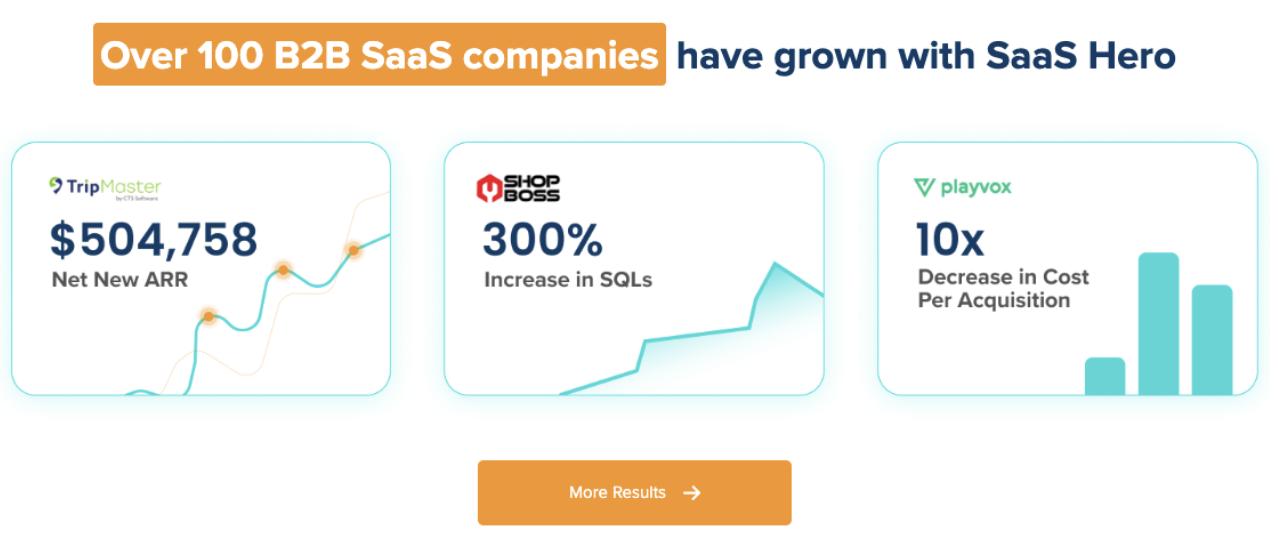
The flat retainer indexed to total monthly ad spend removes the channel-count conflict. A healthy flat-fee SaaS PPC engagement should deliver a retainer-to-sourced-MRR ratio of 5x to 12x annually at Series B stage, with outcomes judged after the 90–120 day ramp period once campaigns exit learning phases and CRM attribution is established. SaaSHero’s published case results include $504,758 in net new ARR for TripMaster over one year, an 80-day CAC payback period for TestGorilla, a 10x reduction in cost per lead for Playvox, and a 305% conversion rate increase for Shop Boss.

Engagement Limits and Trade-Offs
SaaSHero does not serve B2C, ecommerce, or pre-revenue companies. Organic social remains out of scope. The firm is too small for multi-region or agency-of-record mandates. Engagements require the client to implement CRM tracking changes, so RevOps alignment is a prerequisite. The model assumes an internal marketing team of two to four people; companies with no internal marketing function are a weaker fit.
Best-Fit Customer Profile
The strongest fit is a B2B SaaS company at $10M–$50M ARR, spending $15,000 or more per month on paid media, with a sales-led motion, a functioning CRM, and a marketing team that has judgment but no paid media specialist. PE-backed companies with board-level pipeline pressure are a particularly strong fit because the reporting model mirrors the questions a PE operating partner asks.
Onboarding, Integration, and Client Requirements
Onboarding covers conversion tracking rebuild, CRM and marketing automation integration, campaign architecture, audience construction, and creative and landing page production. The client must provide access to Google Tag Manager, ad accounts, analytics, CRM, and marketing automation. A detailed onboarding document covering ICP, competitive landscape, positioning, and messaging must be completed before any campaign is built.
How Hey Digital, Directive, and Refine Labs Compare
Hey Digital
Hey Digital is a SaaS-focused paid media agency with an in-house creative team and documented CRM reporting capabilities. The firm covers paid search and paid social for SaaS companies and produces creative in-house. CRM attribution depth and the specific primary/secondary conversion hierarchy implementation are not publicly detailed at the same granularity as SaaSHero’s methodology. Pricing is retainer-based; whether a percentage-of-spend component applies is not publicly confirmed. Hey Digital suits SaaS companies that want a SaaS-specialist agency and are less focused on explicit design-to-CRM ownership.
Directive
Directive is a performance marketing agency for SaaS and technology companies with documented pipeline and revenue reporting, Salesforce integration, and an in-house performance creative studio. The firm publishes a customer generation methodology that emphasizes pipeline over lead volume. Pricing is retainer-based, with the full structure not public. Directive fits companies that want a larger agency with enterprise-grade reporting and are comfortable with a more consultative engagement model. The primary/secondary conversion hierarchy and the specific 90-day launch cadence are not publicly documented at the same level of operational detail.
Refine Labs
Refine Labs operates primarily as a demand strategy and revenue attribution consulting firm. Its published methodology emphasizes dark social, demand creation, and revenue attribution frameworks rather than in-house creative production or landing page ownership. The firm fits companies that need a strategic demand generation framework and have internal or separate execution resources. It is a weaker fit for companies that need a single team to own creative production, landing page testing, and CRM attribution at the same time. Creative velocity and the design-to-CRM loop are not core published offerings.
Agency Fit for Mid-Market, PE-Backed, and Founder-Led Teams
Mid-market scaling ($20M–$50M ARR, $30k+ monthly ad spend)
Companies at this stage usually have a funded marketing team, a functioning CRM, and a board asking for pipeline coverage ratios. The binding constraint is often attribution quality and creative velocity rather than channel access. SaaSHero’s primary/secondary conversion architecture and CRM-connected reporting address this problem directly. Directive is a credible alternative when the company needs enterprise-grade Salesforce reporting and a larger agency footprint. The trade-off is a more consultative and less prescriptive 90-day operating model.
PE-backed portfolio companies
PE operating partners need consistent methodology, comparable reporting across portfolio companies, and a partner who can be introduced to a new portco without re-teaching the model. SaaSHero’s documented onboarding process, standardized Looker Studio and HubSpot dashboards, and phased validation model align with value creation plans. The flat retainer also survives CFO scrutiny better than a percentage-of-spend arrangement. Flat monthly retainer pricing for B2B SaaS marketing agencies detaches agency compensation from client ad spend levels, enabling unbiased recommendations on budget reallocation, cuts, or increases during creative optimization and testing cycles.
Founder-led teams ($10M–$20M ARR)
Founders or CEOs who still own marketing need a partner who reduces the number of decisions routing through them. SaaSHero’s proactive operating model, arriving at calls with the next test already scoped, supports that need. The risk is that a founder-led company can shift strategic direction quickly, which creates approval latency. Hey Digital is an alternative when the founder wants a SaaS-specialist agency with a lighter operational footprint. Refine Labs fits when the primary need is a demand strategy framework rather than execution ownership.
Ownership and Risk Factors After the First 90 Days
The 90-day validation gate acts as a measurement checkpoint, not the end of the ramp. Several ownership factors determine whether the engagement compounds or plateaus after that point.
Ramp-up time and data volume move together. Meta recommends running A/B tests for at least 7 days and caps them at 30 days, supporting a testing cadence fast enough to identify winners within a 90-day quarter while allowing the ad set to exit the learning phase. An account that launches with a rebuilt conversion architecture needs at least one full sales cycle, typically 90 to 180 days for mid-market B2B SaaS, before closed-won data can validate the optimization signal.
Data portability sits in the contract, not in goodwill. SaaSHero operates inside the client’s own accounts throughout the engagement, so ad accounts, conversion tracking configurations, landing page files, design files, and dashboards belong to the client and remain with them at offboarding. CMOs evaluating any agency should ask explicitly who owns the accounts, the creative files, and the historical data if the relationship ends.
Creative fatigue remains a standing operational risk. Enterprise B2B SaaS campaigns often hit creative fatigue after 4–5 weeks, with CPCs routinely exceeding $40. An agency that treats creative as a launch deliverable instead of a continuous production discipline will see performance degrade predictably after the first quarter. The key question after 90 days is whether the agency has a standing system for replacing launch creative.
Vendor lock-in risk concentrates in three areas: account ownership, attribution data, and reporting infrastructure. An agency that hosts landing pages on its own domain, manages ad accounts under its own MCC, or builds dashboards in proprietary tools creates switching costs that are not visible at contract signing. CMOs should require written confirmation of account ownership and offboarding terms before the engagement begins.
Decision Checklist for Selecting a Revenue-Focused Partner
The seven-item checklist below moves from creative control through attribution infrastructure to long-term operational ownership. Each question tests whether the agency owns a specific link in the design-to-CRM chain.
- Confirm the agency owns landing page design, build, and testing, not just the ad account. An agency that cannot change the landing page headline cannot close the design-to-CRM loop.
- Ask what conversion events are sent to the ad platform for optimization. If the answer is “demo requests” or “form fills” without a primary/secondary distinction, the bidding algorithm is being trained on the wrong signal.
- Request a sample CRM-connected dashboard. If the agency’s reporting lives in a PDF of platform metrics, it cannot answer the pipeline questions a board asks.
- Confirm the pricing model and ask whether the fee changes if a channel is added, removed, or reweighted. A fee that moves with channel count creates a structural conflict on the channel-mix recommendation.
- Ask who will be in the account in month seven and whether they are full-time employees. The answer shows whether the messaging cadence built in month one will still be understood in month nine.
- Request the agency’s 90-day launch plan in writing. A plan that excludes conversion tracking rebuild, a primary/secondary conversion architecture, and a defined validation gate is a media management plan, not a revenue measurement plan.
- Confirm data portability terms in the contract. Every account, file, and dashboard should belong to the client throughout the engagement and at offboarding.
Frequently Asked Questions
What is a realistic creative testing velocity for a B2B SaaS company spending $15,000–$30,000 per month on paid media?
At that spend level, a well-structured B2B paid media program should complete between 8 and 15 creative tests per month across paid search and paid social combined. Teams operating at the high end of that range, near the 15–20 tests per month benchmark discussed earlier, typically achieve a Time-to-Learning of 7–10 days per cycle. That cadence compounds into a meaningful learning advantage over lower-velocity programs within two quarters. The practical ceiling at $15,000–$30,000 monthly spend is about 15 variants per month before diminishing returns on test volume appear. The binding constraint is usually production capacity, not budget, because the agency must generate distinct creative concepts fast enough to keep the testing pipeline full. An in-house creative team with designers and copywriters on the same account is the structural requirement for sustaining that cadence.
How does a primary/secondary conversion hierarchy actually work in a Google Ads or LinkedIn account?
A primary conversion is the event used for account-wide Smart Bidding optimization, typically a sales-qualified lead, a qualified opportunity created in the CRM, or a lifecycle stage transition that the sales team agrees represents genuine buying intent. A secondary conversion is tracked and visible in reporting but is explicitly excluded from the bidding signal. Content downloads, webinar registrations, newsletter signups, and unfiltered contact form submissions are common secondary conversions. The practical implementation requires rebuilding conversion tracking in Google Tag Manager, configuring the ad platform to mark secondary events as “observation only,” and connecting the CRM so that lifecycle stage changes, such as when a lead becomes an SQL or an opportunity is created, can be returned to the platform as the primary optimization signal. Without this separation, the bidding algorithm treats a student downloading a whitepaper as equivalent to a VP of Engineering requesting a demo and trains the account toward the cheaper-to-convert population over time.
Why does flat-fee pricing produce better creative testing outcomes than percentage-of-spend pricing for B2B SaaS?
Under a percentage-of-spend model, an agency that improves creative performance enough to hit pipeline targets on lower spend directly reduces its own fee. That structure discourages aggressive creative testing and optimization velocity because the agency earns more by keeping spend high than by making spend efficient. Under a flat retainer indexed to total monthly ad spend, the agency’s revenue does not change when the channel mix shifts, when a channel is paused, or when a budget reallocation is recommended. That alignment means the creative testing recommendation and the budget recommendation can be made on the evidence rather than on the fee consequence. CMOs can test this by asking what happens to the fee if spend drops by 30% because creative optimization made the program more efficient. The answer reveals the incentive structure more clearly than any pricing document.
What CRM and marketing automation integrations are required before a revenue-focused ad design engagement can produce meaningful data?
The engagement requires a functioning CRM, HubSpot or Salesforce, with defined lifecycle stages that the sales team actively maintains. It also needs a marketing automation platform that captures lead source and campaign attribution at the point of form submission, Google Tag Manager with access granted to the agency, and a conversion tracking configuration that can be rebuilt rather than inherited. The most common gap is the connection between the ad platform click and the CRM record. Without a GCLID or LinkedIn Insight Tag match preserved through the form submission and into the CRM lead record, the attribution loop cannot close. ABM and intent platforms such as 6sense or Demandbase are valuable additions but are not prerequisites. The engagement can begin without them but cannot begin without a CRM that has clean lifecycle stage definitions and a sales team that uses them.
How should a CMO evaluate a 90-day pilot against revenue outcomes when the sales cycle is longer than 90 days?
A 90-day pilot cannot produce closed-won revenue data for a company with a 6–9 month sales cycle. The correct measurement framework for a 90-day validation period uses leading indicators that predict downstream revenue: sales-qualified lead volume by channel, cost per SQL, opportunity creation rate from SQLs, and pipeline coverage ratio. These are CRM outcomes, not platform metrics, and they require the attribution loop to be functional before the pilot begins. That requirement explains why conversion tracking rebuild and CRM integration happen in the first 30 days of a well-structured engagement. The 90-day gate validates the channel thesis, the conversion architecture, and the messaging direction, not closed revenue. A pilot that reports only on form fills or cost per lead at day 90 has not validated anything about revenue.
Key Trade-Offs Before Starting a 90-Day Pilot
A 90-day pilot with any revenue-focused agency requires the client to implement CRM tracking changes, grant account access across ad platforms and analytics, and commit internal time to onboarding and approvals. The return on that investment is a functioning attribution loop and a validated channel thesis, but only when the agency owns the full design-to-CRM chain. A pilot with an agency that stops at the ad account produces 90 days of platform metrics and no answer to the pipeline question.
The most important trade-off to evaluate before starting is scope versus accountability. An agency with a narrow scope, such as the ad account only, can execute faithfully within that scope and still produce a result nobody owns because the landing page, the conversion tracking, and the CRM connection belong to other parties. An agency with a wider scope, including creative, landing pages, attribution, and the ad account, is accountable for the full chain and can be evaluated on pipeline outcomes instead of platform metrics.
The second trade-off is pricing model versus recommendation quality. A flat retainer removes the incentive conflict on channel-mix recommendations. A percentage-of-spend model preserves that conflict. The conflict is structural, not personal, and operates whether or not anyone at the agency acknowledges it.
The recommended next step is a requirements-gathering conversation that covers four questions: what conversion events are currently sent to the ad platform, whether the CRM has clean lifecycle stage definitions, who owns the landing pages the campaigns point to, and what the current reporting shows at the pipeline level. The answers to those four questions locate the gap more precisely than any agency proposal.
SaaSHero’s discovery process starts with exactly those questions. When the answers reveal a broken attribution loop, a landing page owned by a backlogged web team, and reporting that stops at form fills, the 90-day pilot is designed to fix all three at the same time, not sequentially.