




Written by: Aaron Rovner, Founder, Saas Hero | Last updated: August 29, 2026
Key Takeaways for Choosing a SaaS Marketing Partner
- Three non-negotiable terms — flat fee, month-to-month terms, and ARR-tied reporting — disqualify roughly 80% of marketing agencies before any pitch call.
- Early-stage SaaS companies must match retainer tiers to realistic deliverables. Retainers in the $2k–$4k range fund single-channel execution only and require the client to supply strategy.
- Percentage-of-spend or per-channel pricing creates incentive conflicts that push agencies to increase budgets regardless of pipeline impact.
- Contract red flags such as long terms without performance gates, refusal of CRM integration, and reporting limited to platform metrics justify immediate disqualification.
- Once a company crosses $10M ARR and $15k monthly ad spend, SaaSHero’s flat-fee, month-to-month, CRM-tied growth team becomes the only model in this guide that removes incentive conflicts and scope gaps.
We Have $8k MRR: Why Founder-Led Acquisition Still Matters
At $5k–$50k MRR, what actually moves the needle is founder-led acquisition focused on a validated ICP, not outsourced agency spend. A founder comparing three agency retainers at this stage is not choosing between good and bad options. They are choosing between options with different incentive structures, scope boundaries, and contract terms, most of which burn runway before the misalignment becomes visible. Many B2B marketing agencies require a 3- to 6-month minimum contract commitment, which turns a nominal $10,000 monthly retainer into a $60,000 legal liability. The framework below maps realistic deliverables to budget bands and surfaces the contract terms that force immediate disqualification.
Get an objective read on whether your current agency shortlist will survive this filter and fits your stage — book a discovery call to apply the framework.
What to Expect from a $2k–$4k Monthly Retainer
Roughly half of agencies set a minimum retainer of $2,000 per month or less, so the $2k–$4k band is where most early-stage founders start. The deliverables at this tier stay intentionally narrow.
The table below shows exactly what each budget tier delivers, and more importantly, what it excludes, so you can match expectations to what the retainer actually funds.
| Budget Band | Typical Deliverables | What Is Not Included |
|---|---|---|
| $2k–$4k/mo | Single-channel execution (SEO, paid search, or content), monthly traffic/lead reports, basic optimization | Multi-channel strategy, landing page ownership, CRM-tied reporting, positioning or ICP definition |
| $5k–$8k/mo | 1–2 channels managed, dedicated account lead, bi-weekly reporting, basic conversion optimization | Full-funnel demand creation, in-house creative production, ARR-tied attribution, proactive strategy |
| $9k–$15k/mo | Multi-channel strategy, dedicated strategist, weekly or bi-weekly reporting with custom dashboards, CRO, advanced analytics | Varies by agency. CRM integration and landing page ownership must be confirmed, not assumed. |
At the $2k–$4k tier, clients must supply their own strategy and positioning. This means that if your ICP is not yet validated, an agency executing at this tier will produce activity that cannot be evaluated for pipeline impact. The agency is executing your unclear strategy, not fixing it. For this reason, disqualify any agency at this tier that promises integrated multi-channel growth, which requires strategic oversight the retainer does not fund. Integrated multi-channel (omnichannel) demand generation can start at $6,000 per month for growth-stage setups spanning 5+ channels with automation and attribution tools.
What to Expect from a $5k–$8k Monthly Retainer
Moving up to the $5k–$8k band, founders expect the additional budget to unlock multi-channel execution. In practice, this is where scope promises begin to outpace what the fee actually funds. At the $3,000–$5,000 tier, agencies typically manage 3–4 channels and produce 20–40 pieces of content per month. Shifting to $5k–$8k usually adds a dedicated account lead and more frequent reporting, but the structural gaps remain. Landing pages stay outside scope, CRM integration is rarely included, and the agency still waits for the client to set the strategic agenda.
Smaller B2B startups typically pay $2,000–$7,500 per month primarily for single-channel execution such as isolated LinkedIn Ads management or baseline SEO. If an agency at this tier bills a percentage of ad spend rather than a flat fee, the incentive conflict is immediate. Percentage-of-spend models average 10%–20% of budget, which means the agency earns more every time it recommends increasing spend, regardless of whether the data supports that recommendation.
What to Expect from a $9k–$15k Monthly Retainer
The $9k–$15k band is where genuine multi-channel execution becomes structurally possible. Mid-market agencies at roughly $7,500–$15,000 per month typically deliver multi-channel strategy with a dedicated account manager or strategist, monthly or weekly reporting with analytics and attribution, and conversion rate optimization in the premium tier. This is also the band where SaaSHero’s Growth Team entry point sits, at $4,000 per month for companies at the qualifying spend floor, with the engagement scaling against total monthly ad spend rather than channel count.

For companies approaching $10M in annual revenue with $15k+ in monthly ad spend already deployed, this band becomes the graduation threshold. At this point, data volume is sufficient to support the optimization methods a full growth team uses, and runway is deep enough to fund the attribution infrastructure those methods require. Below this level, founder-led acquisition or a tightly scoped single-channel agency is usually the more defensible use of runway because the engagement shape that produces CRM-tied results cannot yet be funded. Above it, a flat-fee, month-to-month, CRM-tied growth team is the only model in this comparison that removes the incentive conflicts and scope gaps that define the alternatives.
Side-by-Side Comparison of Engagement Models
The table below isolates the core incentive conflict in each engagement model, which is the structural reason each model can push the agency toward decisions that may not align with your pipeline goals.
| Model | Typical Price Range | Incentive Conflict |
|---|---|---|
| Flat-fee growth team (e.g., SaaSHero) | Fixed monthly retainer; fee indexed to total ad spend, not channel count | None. Channel mix recommendations carry no fee consequence. |
| Percentage-of-spend agency | 10%–20% of media budget, with a wider band of 15%–30% in circulation | Agency revenue rises with budget increases regardless of performance. |
| Per-channel agency | $2,000–$7,500/mo for single-channel, rising with each channel added | Adding a channel raises the invoice before it returns anything, so budget calcifies where first placed. |
| In-house hire | True cost of 2–3 marketers often exceeds a mid-market agency retainer | One person rarely covers paid search, paid social, creative, landing pages, and attribution at specialist depth. |
Specialist contractors form a fifth option. They deliver deep, low-cost expertise in one platform but produce no owned outcome across disciplines. Coordination lands on the founder, who has the least available time.
Red Flags in Agency Contracts for Bootstrapped Teams
These contract terms are red flags that justify immediate disqualification. No further evaluation is required when any one of them is present.
- Long minimum contract terms without performance gates. Many B2B agencies require 3- to 6-month minimum commitments, which turns a $10,000 monthly retainer into a $60,000 liability. Month-to-month terms without fixed contracts are essential below $8k monthly.
- Refusal to integrate with the client’s CRM. An agency that cannot connect campaign data to pipeline and revenue cannot optimize toward qualified outcomes. It optimizes toward form fills by default.
- Percentage-of-spend billing. Percentage-of-spend models create incentives to increase client budgets regardless of performance. Every budget recommendation carries an undisclosed financial interest.
- Per-channel pricing. When each additional channel raises the fee, the agency has a structural interest in the channel mix staying exactly as it is. Testing a new channel becomes a contract negotiation.
- No data ownership clause. Termination and transition assistance clauses should require the vendor to return customer data in a usable standard format. An agency that retains ad accounts, creative files, or conversion tracking configurations at exit is holding leverage, not delivering service.
- Auto-renewal with a long notice window. Many contracts include evergreen auto-renewal clauses that lock the buyer into another full term unless written notice is provided within a 30- to 90-day window. Calendar the non-renewal deadline at signing.
- Reporting limited to platform metrics. Impressions, clicks, and cost-per-lead are not pipeline. Any agency whose reporting stops at the ad platform boundary cannot answer whether the spend produced revenue.
Pipeline Metrics vs Vanity Metrics
ARR-tied reporting is non-negotiable because the ad platform’s optimization algorithm finds whatever it is rewarded for. When that reward signal is form fills rather than closed revenue, the algorithm systematically discovers the cheapest people to convert, such as students, job seekers, and competitors, while reporting a falling cost per conversion that looks like success but produces no pipeline. Without accurate multi-touch attribution connecting ad spend to closed-won revenue, both in-house teams and agencies become expensive because budget gets misallocated to channels that generate vanity metrics rather than pipeline.

The test is simple. Ask any agency under evaluation whether they optimize campaigns around CRM data or form submissions. An agency that does not control the measurement layer, the landing page, and the CRM connection cannot answer the question honestly. Most cannot.
See how CRM-tied reporting changes what your ad spend actually produces and where budget should shift next — schedule a call to review your current attribution setup.
Build vs Hire Qualification Checklist
Before applying any of the agency evaluation criteria above, founders must determine whether outsourced spend is the right move at all. The checklist below identifies the conditions that must be met before any agency engagement makes sense. If any condition is not met, founder-led acquisition is the correct path.
- Is the ICP validated with at least 10–20 closed customers? Outsourced models perform better only after messaging, ICP, and process are already validated. If not, run founder-led acquisition first.
- Can the founder explain the buyer’s core problem in the buyer’s own language without scripts? Founders who cannot do this will struggle to acquire early customers regardless of later agency support. If not, continue founder-led sales.
- Is monthly ad spend already at $15k or above? Below this floor, data volume is insufficient for the optimization methods that justify agency fees. If not, stay founder-led or use a tightly scoped single-channel contractor.
- Is annual revenue at or above the $10M threshold established earlier? Below this level, the engagement shape that produces CRM-tied results, including a full growth team with in-house creative, landing page ownership, and attribution infrastructure, is not yet the right use of runway. If not, defer the full-team engagement.
- Does the company have an internal marketing team of 2–4 people with no paid media specialist? This is the shape a flat-fee growth team is built for. If yes, proceed to agency evaluation using the disqualification filter above.
Agency Evaluation Checklist for SaaS Founders
Apply this checklist to every agency under evaluation. A single “no” answer is sufficient to disqualify that option.
- Does the agency offer a flat monthly retainer independent of ad spend volume?
- Is the engagement month-to-month, or does it include a performance gate before any longer commitment?
- Does the agency connect campaign reporting to CRM pipeline and revenue, not form-fill counts?
- Does the agency own landing page design, build, and testing as part of the retainer?
- Does the client retain full ownership of all ad accounts, creative files, and conversion tracking configurations at exit?
- Does the contract include a data portability clause with a defined transition assistance period?
- Is the fee indexed to total monthly ad spend rather than the number of channels managed?
- Does the agency arrive with a strategic agenda, or does the client supply the test ideas?
Frequently Asked Questions
What contract length is appropriate for an early-stage SaaS marketing retainer?
Month-to-month terms are the correct starting position for any company below $10M in annual revenue or $15k in monthly ad spend. At those levels, runway is finite and the cost of a misaligned six-month commitment is material. Above those thresholds, a validation period of 60–90 days followed by a longer committed term, typically six months, gives the engagement enough runway to produce clean data across at least one full sales cycle. The validation period should include a defined performance gate, with specific pipeline or attribution milestones that must be met before the longer term activates. Any agency that refuses a validation gate and demands a six-month commitment upfront is protecting itself from accountability, not structuring for results.
Who owns the data and accounts after the engagement ends?
The client should own everything, throughout the engagement and at exit. That includes ad accounts, conversion tracking configurations, landing page files, design files, creative assets, dashboards, and all historical performance data. This is a contractual term, not a courtesy. Confirm before signing that the agency operates inside the client’s own accounts rather than proprietary agency accounts, that all files are delivered in standard formats upon exit, and that transition assistance is included in the contract rather than billed separately. An agency that retains any of these assets at exit has structured the relationship around switching costs rather than results. SaaSHero’s position is explicit: clients own everything, and offboarding is treated as a normal event.
What happens if the agency underperforms?
The answer depends entirely on what was defined as performance at the start of the engagement. Agencies that report on platform metrics such as impressions, clicks, and cost per lead can always find a number that looks acceptable, even when pipeline is flat. The only protection against this is defining performance in CRM terms before the engagement begins, including cost per sales-qualified lead, pipeline created by channel, and CAC payback period. With those definitions in place, underperformance becomes objective rather than arguable. Month-to-month terms then provide the exit mechanism. If the contract is longer, it should include a termination-for-cause clause tied to the agreed pipeline metrics, with a defined cure period, typically 30 days, before the clause activates. Without both the metric definition and the exit mechanism, underperformance has no consequence and the engagement continues until the contract expires.
Conclusion: When to Graduate to a SaaSHero Growth Team
The disqualification framework above eliminates roughly 80% of bootstrapped marketing agency options before any pitch call. Percentage-of-spend billing, per-channel pricing, long contracts without performance gates, refusal of CRM integration, and reporting limited to platform metrics are each sufficient grounds for immediate removal from consideration. What survives the filter is a narrow category: flat-fee, month-to-month, CRM-tied engagements where the agency owns strategy, execution, landing pages, and attribution as one accountable team.

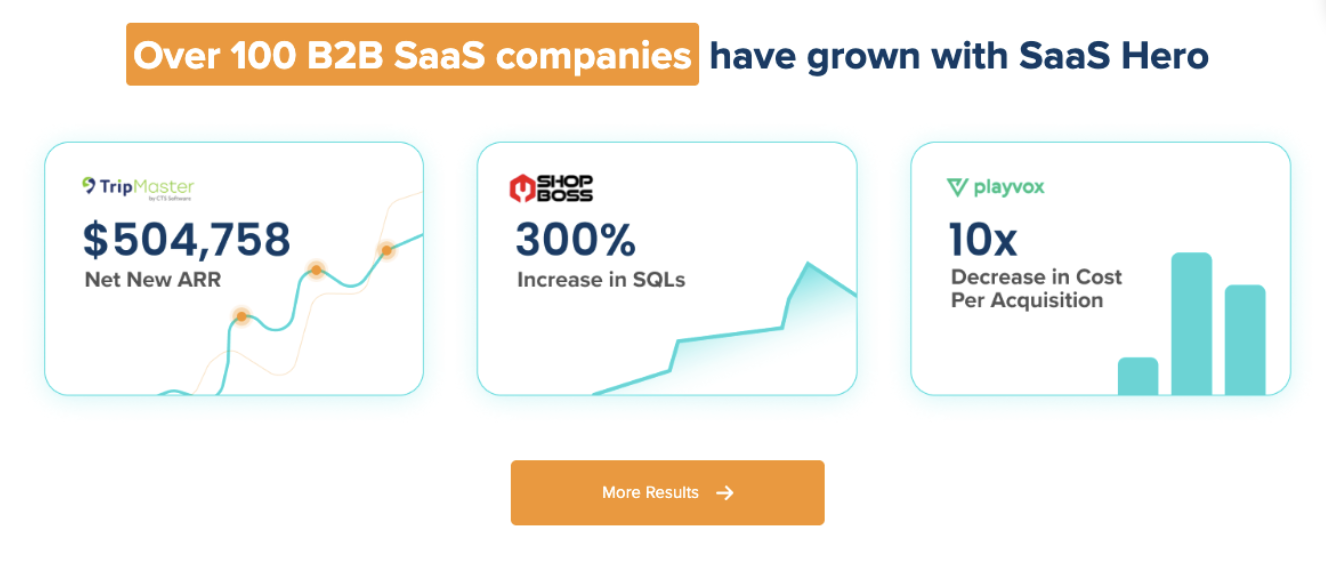
SaaSHero is the benchmark that category is measured against. For companies that have crossed the qualification floor of $10M in annual revenue and $15k in monthly ad spend, SaaSHero operates as the outsourced inbound growth team. The engagement uses a flat retainer indexed to total ad spend, month-to-month terms, in-house creative and landing page production, and reporting built inside the client’s CRM against pipeline and revenue rather than form-fill volume. The engagement is designed so the client supplies goals and approvals, and SaaSHero owns everything between those inputs and the result.
Below the floor, the framework still applies. Use it to disqualify misfit contractors, avoid long commitments, and protect runway until the spend and revenue thresholds are reached. Above the floor, the graduation path is clear, and a CRM-tied growth team becomes the structurally aligned choice.
Apply the disqualification framework to your current agency shortlist and find out whether your spend is ready for a CRM-tied growth team — book a discovery call with SaaSHero.