




Written by: Aaron Rovner, Founder, Saas Hero | Last updated: September 4, 2026
Key Takeaways
- Growth marketing agencies focus on revenue outcomes, running full-funnel experiments that connect ad spend to CRM data.
- 2026 salary ranges for growth marketing roles span $50K–$180K depending on experience, with San Francisco and New York paying 15–30% above national averages.
- Agencies prioritize paid media fluency, analytics and CRM literacy, experimentation discipline, copywriting ability, and AI proficiency when hiring.
- Effective job searches combine major platforms with specialized boards, direct networking, and portfolios built from personal growth experiments.
Ready to explore growth marketing opportunities with a B2B SaaS-focused team? Talk with the SaaSHero team about current and future roles.
What Is a Growth Marketing Agency?
A growth marketing agency is an external team that owns strategy and execution across paid media, creative, landing pages, conversion rate optimization, and attribution. These teams tune campaigns against revenue data rather than vanity metrics.

That focus creates a clear line between growth agencies and traditional marketing agencies. Traditional shops are usually measured on deliverables such as impressions, clicks, and content pieces. Growth agencies are accountable for pipeline and revenue outcomes. They run continuous experiments across the full funnel, from awareness to closed revenue. They also connect ad spend to CRM data instead of stopping at the form fill.
SaaSHero applies this model specifically to B2B SaaS. One team handles paid search, paid social, creative production, landing page design, and CRM-connected reporting. The team optimizes against qualified pipeline, not form-fill counts. SaaSHero’s G2 High Performer status in Digital Marketing reflects this track record and is described in more detail later in this guide.

Learn what it is like to work with a full-funnel B2B growth team.
Where to Find Growth Marketing Agency Jobs
The job search landscape for agency roles has two layers: broad platforms that everyone uses and specialized sources that surface better-matched opportunities. Once you understand what growth agencies do, the next step is knowing where to look for these roles.
Start with the major platforms
LinkedIn remains the default starting point for agency roles. Most agencies post openings there first, and recruiters actively search for candidates. Indeed and ZipRecruiter aggregate listings from across the web. Glassdoor adds company reviews and salary data that help you evaluate employers before applying. LinkedIn is the highest-volume source for agency-side positions, including remote-friendly roles.
Use specialized job boards for better matches
- GrowthHackers Jobs — growth marketing and performance roles with community context
- MarketingHire — niche board for marketing roles, ranked among the top marketing and advertising job sites by Money Magazine
- We Work Remotely — large remote work community with fully remote listings
- Dynamite Jobs — curated remote-first positions with a large candidate database
- Wellfound — strong board for startup growth marketing roles with founder-direct messaging
Use search strategies that surface the right listings
To surface the right listings, start by searching “growth marketing agency” rather than just “growth marketing.” This filters for agency roles specifically. Then set up alerts for “growth marketing agency jobs remote” and “entry level growth marketing agency jobs” to catch new postings within hours of publication. Finally, check company career pages directly, since employers often post roles on their career pages before they appear on larger job boards.
Network your way to unlisted opportunities
Warm introductions are the single most effective sourcing channel for senior growth hires and outperform job-board-only applications. Agencies like SaaSHero frequently hire through referrals and inbound interest before posting publicly. Connect with agency professionals on LinkedIn, engage with their content, and send tailored messages that show you understand their client base and approach.
How Much Do Growth Marketing Agency Jobs Pay?
Salary ranges vary by role, experience level, location, and agency size. The table below draws from Growth.Talent’s 2026 salary guide, based on 500+ job listings cross-referenced with Glassdoor and Levels.fyi data, and from Modern Marketing Institute’s agency compensation benchmarks. All figures are U.S. base salary only and exclude bonus and equity.
| Role | Entry Level (0–2 yrs) | Mid Level (3–5 yrs) | Senior Level (5+ yrs) |
|---|---|---|---|
| Growth Marketing Manager | $60K–$85K | $85K–$130K | $130K–$180K |
| Paid Media Specialist | $55K–$80K | $80K–$120K | $120K–$170K |
| CRO Specialist | $55K–$75K | $75K–$110K | $110K–$155K |
| Account Strategist | $50K–$70K | $70K–$100K | $100K–$150K |
Several variables move these numbers significantly. San Francisco pays 20–30% above the national average and New York 15–25% above, while remote roles at US companies typically pay 10% below the HQ city. Agency size matters too. Boutique agencies often pay below market but offer faster title progression. Larger shops offer structured bands and clearer promotion paths. B2B SaaS and enterprise companies pay 15–30% more than small agencies for the same title, reflecting the complexity of the clients they serve.
What Skills Do You Need for a Growth Marketing Agency Job?
Agencies in 2026 hire against a specific skill profile. The requirements below reflect patterns across current job postings and hiring guides.
Channel expertise
Paid media remains the foundation. Roughly three in four growth marketing job postings list data and analytics skills as non-negotiable, alongside channel fluency in paid acquisition on Google and Meta. Google Ads, LinkedIn Ads, and Meta Ads proficiency is expected for most agency roles. Agencies need people who can build campaign structures, manage budgets, and tune performance toward revenue outcomes.
Conversion and analytics
Landing page optimization and CRO sit at the core of agency services. Growth marketing manager roles typically require paid channel expertise in Google Ads and Meta Ads alongside A/B testing knowledge covering statistical significance and sample size. Analytics fluency with GA4 and Looker Studio is expected. Familiarity with CRM platforms like HubSpot or Salesforce, and how they connect to ad platforms, now appears as a requirement more often than a preference.

Strategic thinking
Agencies value people who connect tactics to business outcomes. Knowledge of CAC, LTV, and pipeline contribution separates strategists from order-takers. The strongest growth marketers are T-shaped, with broad working knowledge across the full funnel and deep expertise in one or two areas.
Data-driven experimentation
Growth marketing runs on testing. AI is raising expectations for test velocity. Growth managers who build AI-augmented experimentation workflows deliver more output with the same team size. Familiarity with A/B testing tools and statistical significance matters more than ever.
AI fluency
Senior growth marketing job postings in 2026 explicitly require candidates to be “AI-fluent by default”, with experience using AI tools for campaign automation, content creation, and workflow. AI proficiency now adds 15–22% to base salary across every marketing role. That premium makes AI skills one of the most powerful levers for compensation growth.
Copywriting
Every ad, landing page, and email needs words that convert. Agencies value marketers who can write compelling copy, not just brief designers and writers. At SaaSHero, headline copy is treated as the single highest-leverage variable on a landing page. The team’s data consistently supports that view.
How to Get a Job at a Growth Marketing Agency: Step-by-Step
- Build a portfolio that proves your skills. You do not need agency experience to demonstrate agency capability. Launch a personal project such as a blog, a landing page, or a small paid campaign, and document the results. Case studies that show measurable outcomes will always outperform a resume that lists responsibilities without results. Running your own experiments on a blog or side project and writing analyses of growth strategies are recommended ways to build a portfolio without a job.
- Gain hands-on experience with the tools. Get certified in Google Ads and Google Analytics. Set up a GA4 property and practice building reports. Create a Looker Studio dashboard. Agencies hire people who can contribute quickly, and tool fluency is the fastest way to prove that readiness.
- Network with agency professionals. Connect with people who work at agencies you admire. Engage thoughtfully with their content. Ask for informational interviews. Sending a tailored one-page growth audit with three actionable recommendations directly to the hiring manager on LinkedIn converts 10x better than a generic application. Direct outreach to agencies like SaaSHero can uncover opportunities that never reach job boards.
- Tailor your resume to highlight growth metrics. Every bullet should quantify impact. Instead of “Managed Google Ads campaigns,” write “Reduced cost per lead by 35% through structured testing and audience refinement.” Candidates are advised to quantify every funnel metric they own, using CAC, LTV, and conversion rate language.
- Prepare for interviews by understanding the agency model. Most growth marketing manager interview processes include a recruiter screen, a hiring manager conversation focused on past results and funnel thinking, and a take-home or live case study where candidates audit a real acquisition channel or propose a growth experiment. Be ready to discuss CAC, LTV, and pipeline, the metrics agencies are hired to move. SaaSHero looks for proactive, data-driven individuals who can own outcomes from day one.
Remote and Entry-Level Growth Marketing Agency Jobs
Remote and entry-level roles attract the most questions from job seekers, and both segments require realistic expectations.
47% of growth marketing listings are remote-friendly as of September 2026. At the same time, remote opportunities skew heavily senior, with only 2% of listings at entry level. The experience breakdown for remote roles shows 45% senior, 40% mid-level, 12% manager, and just 2% entry-level. Entry-level candidates should focus on building transferable skills such as analytics, paid media fundamentals, and copywriting. They should also remain open to hybrid or in-office roles at agencies that invest in junior talent.
Entry-level agency roles do exist. Remote entry-level growth marketing salaries on Indeed range from $40,000 to $65,000 annually for full-time roles, spanning specializations including email marketing, PPC, affiliate marketing, and CRM coordination. Many agencies hire junior marketers for roles that combine coordination with hands-on campaign work, creating a training ground for future specialists.
57% of agencies have slowed or paused entry-level hiring as AI absorbs execution work, while 75% are actively hiring for AI-focused roles that blend creative and technical depth. Entry-level candidates who demonstrate AI fluency alongside core channel skills gain a meaningful advantage.
Career Progression Within Growth Marketing Agencies
Most agency careers start in specialist or coordinator roles and then progress to strategist positions as cross-channel thinking develops. Senior strategists and account directors lead client relationships and own outcomes. Entry-level media buyers at performance marketing agencies typically start in the $45,000–$65,000 range, mid-level strategists with three to five years of experience earn $70,000–$100,000, and senior strategists and heads of paid media can earn $110,000–$160,000 or more.
The agency path offers a compressed learning curve that in-house roles rarely match in the early years. That reality explains why many marketers adopt a hybrid phased strategy. A hybrid phased strategy produces the strongest combination of skills, credibility, and earning power over a full career: spend two to four years at an agency to build a pattern library, then transition in-house for deeper business context and equity upside. Other marketers stay agency-side and move into leadership, where compensation at senior levels reaches $110,000–$175,000 or more.
Agencies typically offer faster title progression in the early years, while in-house roles offer more vertical mobility into VP and C-suite positions over the long term. The choice remains flexible, and most senior marketing leaders have worked in both environments.
What It’s Like to Work at SaaSHero (or Partner With Us)
SaaSHero serves as the outsourced inbound growth team for B2B SaaS companies. One team owns strategy and execution across paid media, creative, landing pages, and CRM-connected reporting. Founded in 2018, the firm has served more than 100 B2B companies and manages over $60 million in lifetime ad spend.
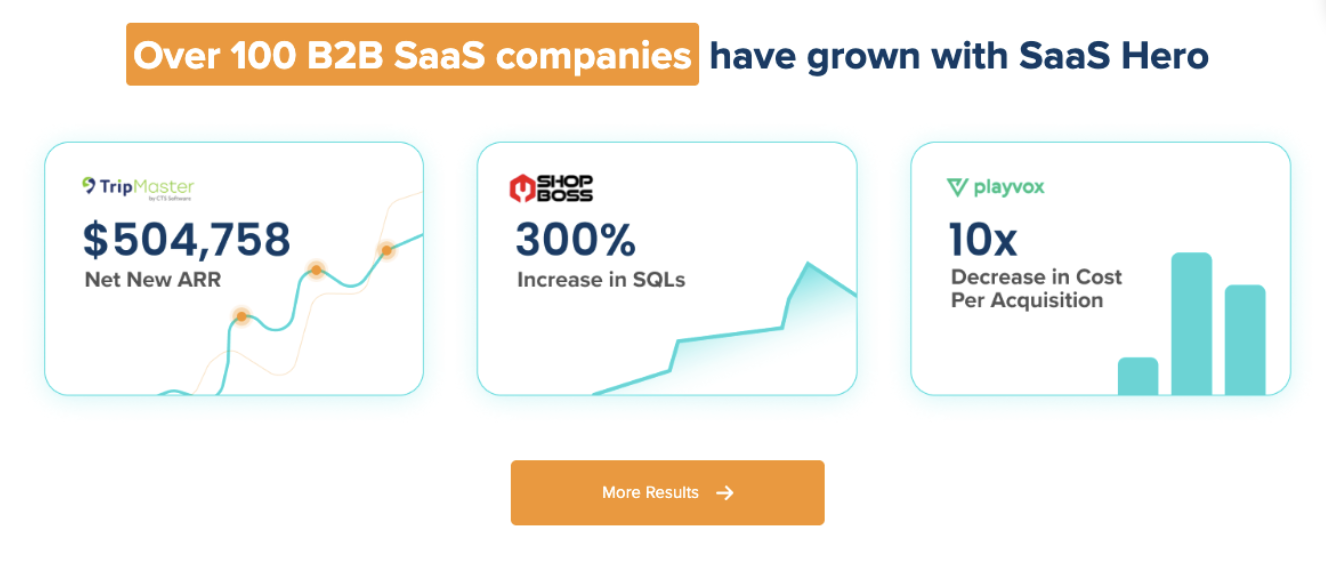
For job seekers, the most meaningful differentiators are structural. The team includes approximately 20 full-time specialists. The work is handled by in-house designers, copywriters, and channel experts rather than contractors or offshore execution layers. SaaSHero is a Google Premier Partner, a designation held by the top 3% of agencies. The firm has been a G2 High Performer in Digital Marketing for over two years and is currently ranked #20 out of roughly 6,000 agencies.
SaaSHero values proactive, data-driven marketers who contribute to both strategy and execution. The firm tunes performance against CRM revenue data rather than form-fill counts, so every team member works with real pipeline metrics. A flat retainer model based on ad spend, rather than channel count, keeps recommendations grounded in evidence. Channel-mix decisions stay strategic, with no fee consequence attached to testing or consolidating channels.
For companies considering an agency partnership, SaaSHero delivers the full inbound growth engine for B2B SaaS. The team covers paid media across major channels, creative production, landing pages and CRO, and CRM-connected reporting that ties ad spend to revenue.
Conclusion: Your 2026 Growth Marketing Career Starts Now
Growth marketing agency jobs remain plentiful in 2026. 830 live growth marketing jobs are listed on Haystack alone as of September 2026, with 185 added in the past week. Landing the right role requires understanding what agencies do, what they pay, and how they hire, not just spotting the listing.
Use the job boards, and then go beyond them. Network directly, build a portfolio that demonstrates growth thinking, and tailor every application to show you understand the agency model. Benchmark your salary expectations against the ranges in this guide. Then invest in the skills agencies actually demand: paid media fluency, CRM-connected analytics, experimentation discipline, and AI proficiency.
If you are ready to work at an agency that values data-driven marketers and owns outcomes end to end, reach out to SaaSHero directly. Explore career and partnership opportunities with the SaaSHero team.
Frequently Asked Questions
What is the difference between a growth marketing agency and a traditional marketing agency?
A traditional marketing agency is typically measured on deliverables such as content pieces, impressions, clicks, and campaign launches. A growth marketing agency is measured on revenue outcomes like qualified pipeline, cost per sales-qualified lead, and closed revenue. Growth agencies run continuous experiments across the full funnel and connect ad spend to CRM data. They remain accountable for what happens after the click as well as before it. These teams own landing pages, conversion tracking, and attribution architecture alongside the ad accounts themselves. In practice, a growth agency implements CRO recommendations, tests the headline, and reports on the pipeline that results.
Does growth marketing pay well compared to other marketing roles?
Growth marketing pays above the general marketing average, particularly at the mid and senior levels. Growth.Talent’s 2026 salary guide puts mid-level growth marketing managers at $85,000–$130,000 in base salary, while the BLS reports a national median of $166,790 for marketing managers broadly under the SOC 11-2021 classification. At the senior level, growth marketing managers at growth-stage startups can reach $130,000–$180,000 in base salary, with total compensation, including bonus and equity, often higher. The 15–22% AI salary premium mentioned earlier further increases earning potential. Location adjustments, outlined in the salary section, can also shift these figures significantly.
How do I get into growth marketing without a traditional marketing background?
Most growth marketers move into the role from adjacent paths rather than entering it directly. Common paths include analyst-to-growth, specialist-to-generalist, product or content to growth, and founder-to-growth. The role rarely appears as entry-level in title, yet the skills are learnable through structured self-study and portfolio building. Start with analytics. Set up a GA4 property, learn basic SQL, and practice building Looker Studio reports. Get certified in Google Ads. Run a small paid campaign on your own project and document the results. Build a case study that shows a hypothesis, an experiment, and a measurable outcome. Agencies and companies hiring for growth roles prioritize demonstrated results over credentials. A degree helps you get read; results get you hired. Direct outreach to agencies with a tailored growth audit that includes three specific, actionable recommendations for their acquisition funnel consistently outperforms a generic resume submission.
What skills do growth marketing agencies prioritize in 2026?
The skill profile agencies demand in 2026 clusters around five areas. First, paid channel fluency: Google Ads, LinkedIn Ads, and Meta Ads proficiency is non-negotiable for most roles, with the ability to build campaign structures and tune performance toward revenue outcomes rather than clicks. Second, analytics and CRM literacy: GA4, Looker Studio, and hands-on experience with HubSpot or Salesforce, including how ad platforms connect to CRM data. Third, experimentation discipline: the ability to form hypotheses, design statistically valid A/B tests, interpret results, and iterate. Fourth, copywriting: the ability to write ad copy, landing page headlines, and email subject lines that convert, not just brief other writers. Fifth, AI fluency: senior job postings in 2026 explicitly require candidates to be AI-fluent by default, with experience using AI tools for campaign automation, content creation, and workflow optimization. Candidates who combine channel depth with CRM-connected measurement skills and AI proficiency are the most competitive in the current market.
Is it better to start a growth marketing career at an agency or in-house?
For the first two to four years of a growth marketing career, agency work typically produces faster skill development. Managing multiple client accounts simultaneously, each with different objectives, audiences, and creative constraints, compresses the learning curve in a way that a single in-house role rarely matches. Agency work builds pattern recognition across industries, channels, and campaign types. The tradeoff involves shallower product knowledge, less ownership of a single business, and a structural salary ceiling that in-house roles with equity can eventually exceed. The most common career path among senior growth marketers is to start agency-side, build a pattern library across accounts, then transition in-house for deeper business context and equity upside. Many then return to agency or consulting work at senior levels. The choice remains flexible, and the skills built at a well-run agency transfer cleanly to in-house roles.