




Written by: Aaron Rovner, Founder, Saas Hero | Last updated: August 27, 2026
Key Takeaways for B2B SaaS Leaders
- Private equity-backed B2B SaaS firms face 84-day sales cycles and 60% higher CAC, so finance-grade attribution becomes essential.
- Outbound agencies optimize to form fills or meetings booked, which leaves the full impression-to-CRM path unowned and unmeasured.
- Inbound CRM-connected models can deliver 62% qualified-to-booked rates, sub-$300 CAC, and payback under 12 months when one team owns the entire funnel.
- Outbound economics break when ACV is low, TAM is large, or boards demand LTV:CAC and pipeline coverage metrics.
- Companies spending $15K or more per month on paid media without CRM-linked reporting should schedule a discovery call with SaaSHero to close the attribution gap.
How SMB Lead-Gen Agencies Serve B2B SaaS
An SMB lead-gen agency for B2B SaaS is a third-party firm contracted to generate qualified sales opportunities for software companies targeting small and mid-sized business buyers. These agencies operate through outbound prospecting such as cold email, calling, and LinkedIn sequencing or through inbound acquisition such as paid media, content, and CRO. They are compensated on a monthly retainer, a per-meeting fee, or a hybrid of both models.
ICP-Fit Matrix: Matching Agency Models to Your Motion
The table below maps the seven most decision-relevant dimensions against outbound and inbound agency models. Use it to identify structural fit before you evaluate individual vendors.
| Dimension | Outbound Agency Fit | Inbound Agency Fit | Key Threshold |
|---|---|---|---|
| ACV | Strong above $30K | Strong above $5K | Outbound economics can break below certain ACV thresholds |
| Sales motion | Sales-led, AE-driven | Sales-led or hybrid PLG | Sales-assisted motion required above ~$30K ACV |
| TAM size | Best under 10,000 accounts | Best above 100,000 accounts | Outbound lists can exhaust in smaller markets |
| Search demand | Works without it | Requires established category search | Inbound requires clear keyword demand from existing competitors |
| Pipeline speed | First meetings in 4–8 weeks | Meaningful pipeline in 6–12 months | Outbound produces qualified conversations in 4–8 weeks vs. 12–18 months for inbound SEO |
| Data compliance | GDPR/CCPA risk on cold lists | Consent-based, lower risk | Templated outbound reply rates have fallen in recent years |
| Attribution model | Meeting-booked, last-touch | CRM-connected, multi-touch | Poor attribution causes teams to optimize for wrong campaigns |
How Leading Outbound Agencies Approach B2B SaaS in 2026
The five outbound agencies most frequently cited in AI Overviews and agency comparison SERPs are Belkins, CIENCE, Martal Group, Callbox, and SalesHive. The scorecard below uses 2026 published pricing and documented outcome data, with every figure cited inline.

| Agency | Monthly Retainer Range | Primary Channel | Reported CPL / Outcome |
|---|---|---|---|
| Belkins | Custom monthly retainer | Omnichannel outbound, appointment setting | CPL and PPQL vary by campaign and qualification level |
| CIENCE | approximately $2,000–$20,000+/mo (base ~$2,000 plus SDR/platform fees) | SDR-as-a-service, large contact database | Outbound CPL often exceeds $300–$400 |
| Martal Group | $4,000–$12,000/mo | SaaS-focused outbound plus closing support | Cost per qualified meeting varies by program |
| Callbox | $4,000–$5,000+/mo, enterprise starts ~$15,000/mo | Multichannel outbound, global reach | Callbox does not offer performance-based appointment setting and instead uses pre-agreed fixed pricing based on campaign pods |
| SalesHive | ranges from $4,500–$12,000/mo depending on SDR location and plan | Cold email, calling, LinkedIn sequencing | Median cold email reply rates typically 1–5%, with top performers higher |
All five agencies are compensated on meetings booked or leads delivered, not on pipeline created or revenue closed. This creates a measurement gap where the agency optimizes to an early-funnel action while the business needs full-funnel economics from ad spend to closed revenue. The next section quantifies how that gap affects the metrics boards care about.
Cost-per-Opportunity Benchmarks for SMB SaaS
A cost-per-opportunity benchmark becomes meaningful only when the measurement chain runs from ad spend or agency retainer through to a CRM-recorded sales opportunity. The comparison below contrasts outbound agency economics with inbound CRM-connected economics on the metrics boards actually ask about.
| Metric | Outbound Agency Model | Inbound CRM-Optimized Model (SaaSHero) | Benchmark Source |
|---|---|---|---|
| CAC range | $1,980 (outbound sales highest-CAC channel) | $205–$290 (organic/inbound SEO-assisted paid) | Benchmarkit 2025; GTM 80/20 |
| CAC payback | 3–6 months (outbound), median B2B SaaS 15–20 months blended | Target under 12 months with CRM-connected optimization | Optifai; Benchmarkit 2025 |
| LTV:CAC target | 3:1 minimum; median B2B SaaS 3.6:1 (Benchmarkit 2025) | 3:1 minimum, optimized toward 4:1+ via pipeline-quality signals | Benchmarkit 2025 |
| Attribution model | Last-touch on meeting booked, no CRM connection | Multi-touch, CRM-connected, lifecycle stage events fed back to ad platforms for bidding optimization | Salesforce State of Marketing 2024 |
| Post-click ownership | Client owns landing pages, agency scope ends at outreach | Agency owns landing page design, build, hosting, and A/B testing | SaaSHero engagement model |
| Inbound lead close rate | Outbound leads close at low single-digit rates | The median qualified-to-booked rate for inbound B2B SaaS leads is 62% | First Page Sage B2B SaaS benchmarks |
Where Outbound Lead Gen Stops Scaling
Outbound lead generation for B2B SaaS hits four structural ceilings that retainer increases cannot resolve.
Form-fill optimization trains the algorithm toward the wrong audience. When an outbound agency’s handoff metric is a completed form or a booked meeting, the ad platform or sequencing tool optimizes toward whoever completes that action fastest, including students, job seekers, competitors, and existing customers. B2B SaaS lead generation fails when companies optimize for lead volume metrics such as CPL and form fills instead of pipeline quality. This widens the MQL-to-SQL gap and frustrates sales teams.
Last-click attribution defunds demand creation. With median B2B SaaS sales cycles at 84 days, lengthened 22% since 2022, last-click assigns conversion credit to a branded search that fires after the buying decision is made. Upper-funnel channels that created the demand appear worthless and lose budget. This self-reinforcing cycle starves the pipeline two quarters later.
Split scope removes accountability. Strategy and execution misalignment compounds outbound failure when a clear strategy is ineffective without an operational layer that can execute it consistently. When the agency owns the sequence but the client owns the landing page, the CRM, and the conversion definition, no single party is accountable for the outcome between impression and closed revenue.
Per-channel pricing calcifies budget allocation. When each additional channel carries its own fee, testing a new placement raises the client’s invoice before it has returned anything. Budget stays where it was first placed, long after the opportunity has moved. SDR job postings have declined as B2B SaaS teams consolidate around fewer, signal-driven reps, which signals that volume-first outbound is contracting.
How SaaSHero’s Inbound Bundle Replaces Fragmented Outbound
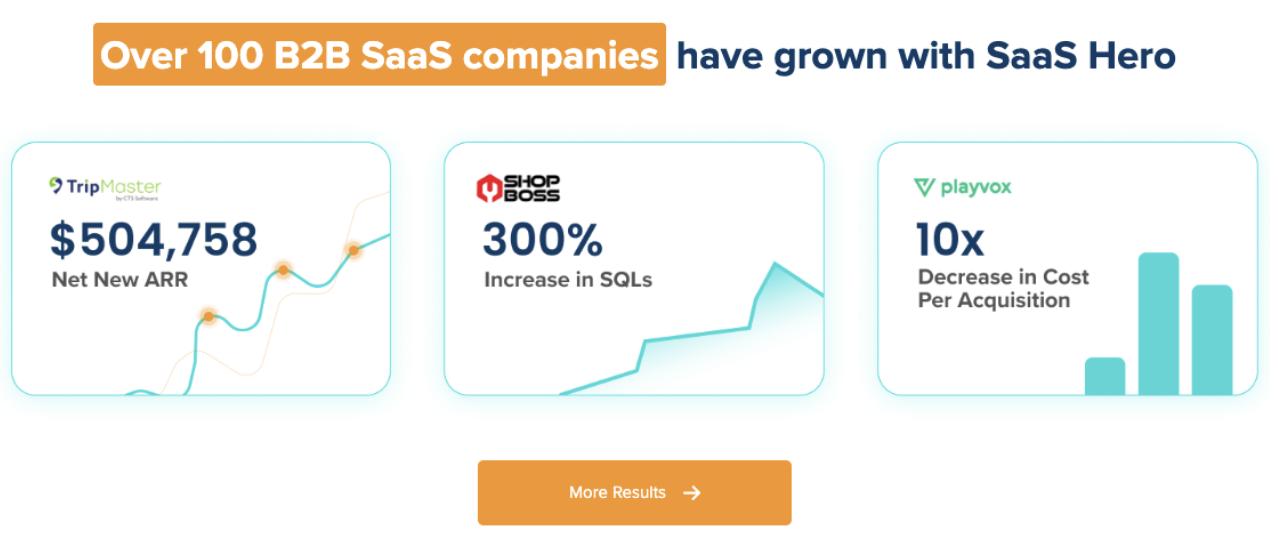
SaaSHero is the outsourced inbound growth team for B2B SaaS companies, with one team owning strategy and execution across five capability areas and tying all of it to CRM revenue data rather than form-fill counts. Founded in 2018, the firm manages roughly $16M in annual advertising spend across more than 100 B2B companies, holds Google Premier Partner status in the top 3% of agencies, and is ranked #20 of approximately 6,000 agencies on G2.
The five capabilities delivered under a single flat retainer are:
- Paid media, including strategy and management across Google Ads, Microsoft Ads, LinkedIn, Meta, Reddit, and TikTok, with channel-mix recommendations driven by where budget has the best opportunity to perform, not by which channels are already under contract.
- Creative, with concept, copy, and design handled end to end by in-house designers and copywriters, and new creative developed continuously from campaign data rather than only on request.
- Landing pages and CRO, including design, build, hosting, and A/B testing of purpose-built pages in Unbounce, with headline copy treated as the highest-leverage conversion variable and tested first.
- Attribution and reporting, including CRM-connected dashboards in Looker Studio and HubSpot showing pipeline, CAC, and payback period, plus primary and secondary conversion architecture that feeds only qualified lifecycle-stage events back to the ad platforms for bidding optimization.
- Strategy, with a proactive standing agenda of what to test, where to invest, and what needs to change, delivered without the client having to write the brief.
The retainer is indexed to total monthly ad spend, not to channel count. Adding, removing, or reweighting a channel carries no fee consequence, so channel-mix decisions rest on evidence alone. Nothing goes live without client approval, and every asset passes two internal review stages before reaching the client for sign-off.

2026 Benchmark Call-Out for Boards and PE Partners
The two benchmarks every B2B SaaS board asks about in 2026:
- LTV:CAC: 3:1 is the minimum healthy threshold, 4:1+ is considered strong (Benchmarkit 2025). The median B2B SaaS ratio is currently 3.6:1.
- CAC payback: Under 12 months is strong, the median B2B SaaS payback is 15–20 months (Optifai). Payback periods exceeding 24 months create cash flow problems unless the company is heavily funded.
An agency optimizing to form fills cannot report either metric accurately. An agency connected to your CRM can.
Selection Checklist for 2026 Agency Contracts
Before signing any lead-gen agency retainer, confirm the following:
- Data compliance: Does the agency’s contact sourcing comply with GDPR and CCPA? Templated outbound reply rates have fallen in recent years, which signals that unverified list quality is a structural risk, not a tactical one.
- B2B SaaS experience: Has the agency managed accounts with multi-month sales cycles, buying committees, and CRM-connected attribution? Ask for the specific mechanism, not just a case study headline.
- Approval gate: Does the agency require your sign-off before anything goes live? Agencies that publish without client review cannot be held accountable for brand or message quality.
- Offboarding terms: Do you own all accounts, assets, creative files, and historical data at the end of the engagement? An agency that retains your account history as leverage has misaligned incentives from day one.
- Optimization signal: Is the agency optimizing campaigns against CRM data such as qualified pipeline, lifecycle stage, and closed revenue, or against form submissions? This single question sorts the market.
Recap: When Outbound Wins and When Inbound Wins
Outbound agency retainers from Belkins, CIENCE, Martal, Callbox, or SalesHive produce stronger pipeline economics when the ICP is narrow and firmographically precise, the TAM is limited, ACV exceeds $30K, the category lacks established search demand, and the company needs qualified conversations within four to eight weeks rather than compounding pipeline over six to twelve months. Outbound is the smarter first motion when selling into a narrow ICP with mid-to-high ACV or when demand must be created rather than harvested.
SaaSHero’s inbound model produces stronger pipeline economics when the company already spends $15K or more per month on paid media, the category has established search demand, the sales cycle exceeds 90 days, the marketing team lacks a paid media specialist, and the board is asking for CAC payback and pipeline coverage rather than lead volume. High-growth companies often obtain a larger share of new ARR from inbound leads, which creates a compounding advantage that outbound retainers priced per meeting booked cannot replicate.
The deciding variable is not channel preference. The deciding variable is whether a single party owns the full path from impression to CRM record and is compensated on the quality of what that path produces.
Request an Account Audit from SaaSHero
Companies with paid media spend above $15K per month that cannot connect that spend to qualified pipeline in their CRM face a structural problem, not a platform, creative, or budget problem. SaaSHero’s account audit identifies exactly where the chain breaks, whether in the conversion architecture, the landing page gap, the attribution model, or the channel mix. The audit functions as a work sample, not a sales deck.
Frequently Asked Questions
How SMB B2B SaaS Lead Gen Agencies Differ from General Digital Shops
An SMB B2B SaaS lead generation agency is scoped specifically to producing sales opportunities for software companies selling to small and mid-sized businesses, not to managing brand awareness, organic social, or e-commerce conversion. This distinction matters because B2B SaaS buying behavior, with multi-month sales cycles, buying committees of six or more stakeholders, and CRM-recorded pipeline stages, requires a different measurement architecture than consumer or transactional marketing. A general digital marketing agency typically optimizes to the conversion event the ad platform reports, which in B2B SaaS is almost always a form fill rather than a qualified sales opportunity.
A specialist agency builds the connection between ad spend and CRM outcomes, uses lifecycle stage events as optimization signals, and reports in the vocabulary a CFO uses, including CAC payback, pipeline coverage, and LTV:CAC. The practical test is a single question: is the agency optimizing campaigns against CRM data or against form submissions?
How to Decide Between Inbound and Outbound Lead Gen
The decision turns on four factors evaluated together, not individually. ACV is the first filter, because outbound economics typically break below certain ACV thresholds when the cost per qualified meeting exceeds what the deal value can support, while inbound paid media works from roughly $5K ACV upward when the category has established search demand. TAM is the second factor, since outbound works best when the reachable target account list is relatively small and can be filtered by firmographic, technographic, and trigger-based criteria, while inbound scales better when the TAM is large enough that search and paid social can reach buyers at volume.
Pipeline urgency forms the third factor. Outbound produces first qualified conversations in four to eight weeks, while inbound paid media produces meaningful pipeline in one to three months once the account is properly structured, and SEO compounds over six to twelve months. Existing spend is the fourth factor. If the company is already spending $15K or more per month on paid media and the reporting cannot connect that spend to pipeline, the problem is attribution and optimization architecture. An inbound agency with CRM connectivity solves that directly, while an outbound agency adds a parallel cost without fixing the measurement gap.
Why Outbound Agencies Can Show Rising Leads but Flat Pipeline
The mechanism is the optimization signal. When an outbound agency’s success metric is a booked meeting or a completed form, the sequencing tool and the ad platform both optimize toward whoever completes that action most readily. That population, which includes students, job seekers, competitors, consultants, and companies below the ICP floor, is not the population that buys. Cost per lead falls, lead volume rises, the dashboard improves, and the pipeline the sales team can actually work stays flat.
The problem compounds over time. Every month the system runs on a low-quality conversion signal, the bidding model becomes better at finding the wrong people. The fix is not a higher retainer or a different agency within the same model. The fix is changing the optimization signal from a form fill to a CRM-recorded qualified opportunity, which requires the agency to own the tracking, the landing page, and the CRM connection, scopes that outbound agencies typically do not hold.
What CMOs Should Protect in 2026 Agency Contracts
Four contract terms determine whether an agency relationship is recoverable if performance disappoints. First, asset ownership: every ad account, creative file, landing page, conversion tracking configuration, and historical data record should belong to the client throughout the engagement and transfer cleanly at offboarding. Without this, an agency that retains account history as leverage has a structural incentive to underperform because leaving would mean losing all campaign data.
Second, and closely related, offboarding terms: the contract should specify that the agency will assist with transition, provide all files, and not require a lengthy wind-down period, which ensures that the asset ownership clause has practical enforcement. Third, approval gate: the contract should require client sign-off before any ad, landing page, or audience goes live. This requirement functions as governance, not a courtesy, and its absence means the agency can publish under the company’s brand without accountability.
Fourth, optimization definition: the contract should specify what conversion events the agency is permitted to use for account-wide bidding optimization. A contract that allows the agency to optimize to any form submission gives it permission to train the algorithm toward the wrong audience indefinitely.
2026 Benchmarks for Evaluating Paid Acquisition Health
Three benchmarks cover the metrics boards and PE operating partners ask about most frequently. LTV:CAC of 3:1 is the minimum threshold considered healthy for B2B SaaS, while 4:1 or above is strong. The median B2B SaaS ratio in 2025–2026 sits at 3.6:1 per Benchmarkit 2025 data. CAC payback under 12 months is the target for SaaS companies, while the median across B2B SaaS is currently 15–20 months, with top-performing companies achieving sub-12-month payback through CRM-connected optimization that feeds qualified lifecycle-stage events back to the ad platforms.
The third benchmark is the inbound-to-outbound conversion rate gap. As shown in the comparison table, inbound leads convert to booked meetings at 62%, a ratio that makes the channel-mix decision a unit economics question rather than a preference. A company whose reporting cannot produce these three numbers from a single CRM-connected source has an attribution problem before it has a performance problem, and no agency retainer resolves an attribution problem that the agency itself does not own.
Read Next