




Written by: Aaron Rovner, Founder, Saas Hero | Last updated: September 5, 2026
Key Takeaways
- The 2026 adtech landscape splits between three dominant walled gardens (Google, Meta, Amazon) and independent platforms powering the open internet.
- Google leads with about $315B TTM ad revenue, Meta is projected at $243.46B, and Amazon Ads is the fastest-growing at roughly $76B TTM.
- Independent leaders include The Trade Desk (DSP), AppLovin (mobile), Magnite and PubMatic (SSPs), Criteo (commerce media), and DoubleVerify/IAS (verification).
- Success in AI-automated platforms now depends on feeding high-quality CRM revenue data instead of chasing form-fill volume.
The Walled Gardens: Google, Meta, and Amazon
Google, Meta, and Amazon dominate because they own both the audience and the ad inventory, which gives them unmatched reach and first-party data. Together they account for over 62% of global digital ad spending in 2026, according to eMarketer projections.
Google remains the largest ad revenue generator by trailing-12-month figures, with approximately $315 billion in trailing-12-month ad revenue as of Q2 2026, per SEC filing data. Its dominance spans search, display, YouTube, and the programmatic ecosystem through DV360 and Google Ad Manager. The key differentiator is search intent, reaching buyers at the exact moment they look for a solution.
Meta is projected to surpass Google in global digital ad revenue for the first time in 2026, with forecast net ad revenue of $243.46 billion versus Google's $239.54 billion and expected growth of 24.1% in 2026, driven by AI-powered tools like Advantage+ and expansion into WhatsApp and Threads. Its key differentiator is social targeting and audience building across Facebook, Instagram, and increasingly WhatsApp. Meta has stated its goal to reach fully automated end-to-end ad creation by the end of 2026.
Amazon Ads is the fastest-growing of the three, with Q2 2026 advertising services revenue of $19.8 billion, up 26.2% year over year, and trailing-12-month ad revenue of approximately $76 billion. Amazon's ad business uses purchase intent data at the point of sale. The key differentiator is commerce data, reaching buyers with demonstrated purchase behavior.
These platforms sit at the core of most B2B paid media strategies. Google supports demand capture, while LinkedIn and Meta drive demand creation and audience building. They also require sophisticated management to avoid wasted spend. Their AI-driven automation means the quality of the conversion data you feed them largely determines the quality of the results.
Talk with SaaSHero to see how campaigns change when these platforms optimize against CRM revenue data instead of simple form-fill counts.
Independent Leaders: DSPs, SSPs, and Specialists
Independent adtech companies give B2B marketers alternatives to walled gardens and create more control, transparency, and specialized functions across the open internet.
The Trade Desk is the leading independent demand-side platform (DSP) for programmatic advertising. Fiscal 2025 revenue reached $2.90 billion, up 18% from $2.44 billion in 2024, with Adjusted EBITDA of $1.20 billion. That growth is driven by connected TV, which now accounts for an estimated 40% or more of platform spend. To extend its CTV leadership, The Trade Desk launched OpenAds in January 2026, a publisher-direct auction model with partners including The Guardian, Hearst, and Newsweek.
AppLovin has grown into a large AI-powered mobile advertising platform. Fiscal 2025 revenue reached $5.48 billion, up 16.4% year over year, with net income of $3.33 billion, a 60.8% net margin, and a market capitalization of approximately $106 billion as of September 2026. Its Axon AI engine powers app monetization and has expanded into e-commerce advertising.
Magnite and PubMatic are the leading independent supply-side platforms (SSPs), helping publishers monetize inventory programmatically. Magnite reported 32% top-line connected TV revenue growth in Q4 2025, with CTV exceeding 50% of total contribution ex-TAC by Q1 2026. PubMatic launched its Creator Marketplace in June 2026, the first programmatic CTV auction connecting independent creator media companies with programmatic demand.
Criteo has shifted from pure retargeting to a full-funnel commerce media platform. Its Commerce Media Platform connects over 22,000 brand and agency customers with retail media publishers.
DoubleVerify and Integral Ad Science (IAS) lead the verification and measurement category, ensuring ad viewability, brand safety, and fraud prevention. The Association of National Advertisers estimates invalid traffic and ad fraud cost digital advertisers approximately $68 billion globally in 2025, so the fraud-prevention role makes verification infrastructure essential for any programmatic program.
Categorizing the Ecosystem for Better Vendor Decisions
Use the table below to map each platform to its primary function and differentiator so you can quickly see which vendors support demand capture, demand creation, or verification and which revenue figures are comparable. Revenue figures reflect the most recent available data and are not directly comparable across companies because business models and reporting scopes differ.
| Company | Primary Function | Key Differentiator | Revenue Reference |
|---|---|---|---|
| Walled garden (search, display, video, DSP, SSP) | Search intent, full-stack ecosystem | ~$315B TTM ad revenue (Q2 2026) | |
| Meta | Walled garden (social) | AI-powered audience targeting (Advantage+) | $243.46B projected 2026 net ad revenue |
| Amazon Ads | Walled garden (retail media) | Purchase intent data at point of sale | ~$76B TTM ad revenue (Q2 2026) |
| The Trade Desk | Independent DSP | CTV leadership, OpenAds publisher-direct model | $2.90B fiscal 2025 revenue |
| AppLovin | Mobile ad platform | AI-driven Axon engine, 60.8% net margin | $5.48B fiscal 2025 revenue |
| Magnite | Independent SSP | Largest independent SSP, CTV focus | 32% CTV revenue growth Q4 2025 |
| PubMatic | Independent SSP | Creator Marketplace for CTV | Creator Marketplace launched June 2026 |
| Criteo | Commerce media | Shopper data, full-funnel open internet platform | 22,000+ brand and agency customers |
| DoubleVerify | Verification and measurement | Campaign quality verification | — |
| Integral Ad Science | Verification and measurement | Brand safety and fraud prevention | — |
The Big 4 Confusion: AdTech vs. Agencies
The “big 4” in advertising refers to the four largest advertising agency holding companies: WPP, Omnicom, Publicis, and Interpublic Group (IPG). These groups operate as agencies that provide strategy, creative, and media buying services. Adtech companies, by contrast, provide the technology platforms that execute and measure campaigns.
Publicis Groupe's May 2026 agreement to acquire LiveRamp for $2.2 billion shows how the lines are blurring as agencies acquire adtech capabilities to compete. A B2B company typically works with both. An agency or internal team manages the adtech platforms, while the platforms themselves execute and measure the campaigns.
Given that agencies are increasingly absorbing adtech capabilities, B2B leaders benefit from stepping back to see why these platforms matter in the first place.
Why the Top AdTech Companies Matter for B2B Marketers
The adtech platforms above form the channels through which B2B companies reach buyers. Google Ads supports demand capture, LinkedIn drives demand creation, and Meta and Reddit increasingly help with audience building. Microsoft's ad business, which includes LinkedIn, is forecast to capture 2.1% of global digital ad revenue in 2026, with approximately half coming from LinkedIn.
Most B2B companies already know which channels to use. The real challenge is execution quality. The platforms' AI-driven automation, including Google's AI Max and Meta's Advantage+, combined with Meta's stated goal of fully AI-automated campaigns by the end of 2026, means the critical skill has shifted from interface manipulation to data quality. Teams now win by feeding the algorithms the right conversion signals.
Broken measurement makes this harder. The click is recorded in Google Ads. The opportunity appears in Salesforce months later. Nothing joins them unless someone builds and maintains the integration. Many B2B companies still optimize against form fills instead of CRM revenue data. That pattern trains the algorithms to find the cheapest form-fillers, such as students, competitors, and job seekers, instead of qualified buyers. Dashboards improve while pipeline stays flat.
See a CRM-based optimization model with SaaSHero and compare it with a form-submission approach in your own data.
Introducing SaaSHero: Your Outsourced Inbound Growth Team
That gap between powerful automation and weak data quality is exactly what SaaSHero helps B2B teams close. SaaSHero operates as an outsourced inbound growth team for B2B companies, with one group owning strategy and execution across paid media, creative, landing pages, and reporting so clients avoid day-to-day agency management.

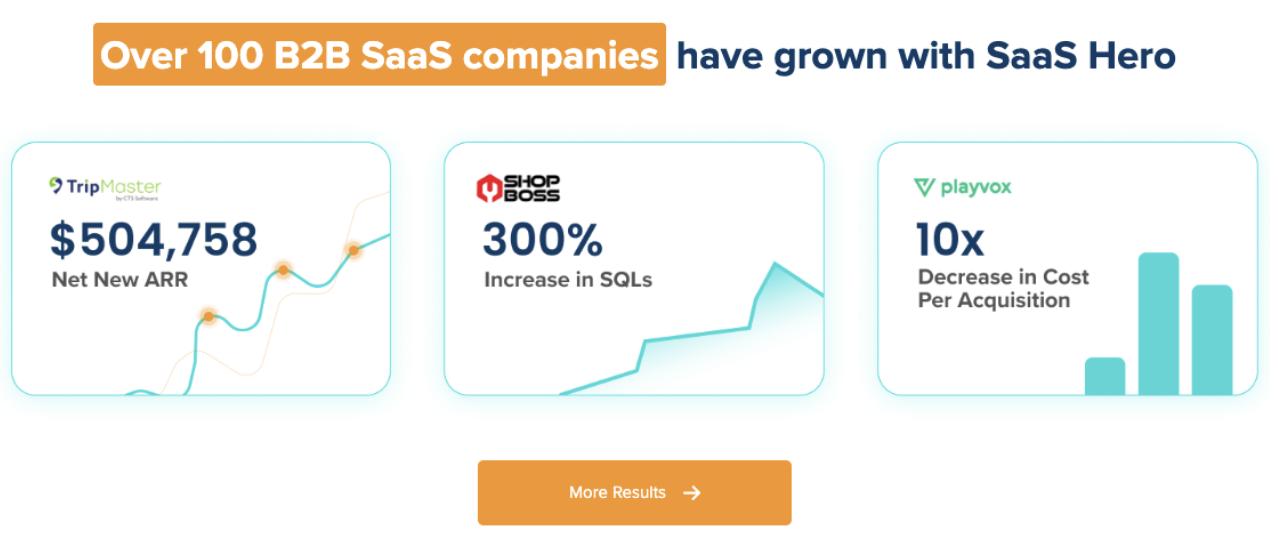
Founded in 2018, SaaSHero has served more than 100 B2B companies and manages approximately $16 million in annual advertising spend, with over $60 million managed over its lifetime.
Key differentiators:
- One team, five capabilities: Paid media (Google, LinkedIn, Meta, Reddit, TikTok), creative (concept, copy, design), landing pages and CRO, attribution and reporting, and strategy, delivered as one integrated team instead of five separately priced services.
- CRM revenue as the optimization target: SaaSHero optimizes against qualified pipeline, lifecycle stage, and closed revenue, not form-fill counts. This approach trains Google and other platforms to find buyers instead of casual form-fillers.
- Flat retainer based on ad spend: Fees align with ad spend, not channel count. Adding or testing a new channel does not increase the fee, which separates recommendations from the invoice.
- Full ownership of the post-click experience: The same team that runs the ads designs, builds, and tests landing pages. This structure closes the gap between click and conversion that many agencies leave open.
- Proven platform recognition: Google Premier Partner status (top 3% of agencies) and G2 High Performer ranking at #20 of approximately 6,000 agencies.
Schedule a strategy session with SaaSHero to explore how an outsourced growth team can manage your full adtech stack against real pipeline outcomes.
Frequently Asked Questions
What are the largest adtech platforms?
The largest adtech platforms by revenue are the walled gardens. As detailed earlier, Google leads with roughly $315B in trailing-12-month ad revenue, Meta is projected at $243.46B, and Amazon sits near $76B. Among independent platforms, AppLovin reported $5.48 billion in fiscal 2025 revenue and The Trade Desk reported $2.90 billion. These figures are not directly comparable because the walled gardens report total advertising revenue across owned-and-operated properties, while independent platforms report platform or services revenue only.
Who are the big 4 in advertising?
The “big 4” refers to the largest advertising agency holding companies: WPP, Omnicom, Publicis, and Interpublic Group (IPG). These groups act as agencies that provide strategy, creative, and media buying services, while adtech companies provide the technology platforms for buying, selling, and measuring digital ads. The distinction matters in practice. A B2B company typically works with an agency or internal team to manage adtech platforms, not with the platforms themselves directly. Publicis's 2026 acquisition of LiveRamp shows how agencies are increasingly acquiring adtech capabilities, but the categories remain structurally distinct.
What is the difference between adtech and martech?
Adtech (advertising technology) enables the buying, selling, and measurement of digital advertising through platforms such as Google Ads, The Trade Desk, and Magnite. Martech (marketing technology) manages customer relationships after they are established through tools such as HubSpot, Salesforce, and Marketo. Adtech reaches potential customers, and martech manages them after they become leads or customers. In B2B, the two stacks must connect. Adtech generates the lead, and martech records what happens to it. Without that connection, optimization defaults to form-fill counts, missing revenue outcomes, which creates the most common and most costly measurement failure in B2B paid media.
How do I choose the right adtech partners for my B2B company?
For most B2B companies, the core decision involves who will manage the platforms effectively rather than which platforms to use. Google Ads and Microsoft Ads are essential for demand capture. LinkedIn is the primary demand-creation channel for many B2B audiences. Meta and Reddit are increasingly viable for audience building and retargeting.
The critical factor is whether campaigns optimize against CRM revenue data or just form submissions. If your current program lacks that connection, the platform mix becomes a secondary concern. Many B2B companies in the $10M–$50M revenue range lack in-house paid media specialists. They often see better results with an outsourced growth team, such as SaaSHero, that owns the entire paid acquisition engine, including landing pages and attribution, instead of managing individual channel vendors separately.
What is the difference between a DSP and an SSP?
A demand-side platform (DSP) is used by advertisers to buy digital ad inventory programmatically across multiple publishers and exchanges. The Trade Desk, Google DV360, and Amazon DSP are leading examples. A supply-side platform (SSP) is used by publishers to sell their ad inventory programmatically to multiple buyers. Magnite, PubMatic, and Index Exchange are leading independent SSPs.
In a programmatic transaction, the DSP bids on inventory made available through the SSP in a real-time auction. For B2B marketers, DSPs matter when running programmatic display or CTV campaigns outside the walled gardens. SSPs function as publisher infrastructure and are not typically selected directly by advertisers.
Conclusion: Turning AdTech Complexity into B2B Pipeline
The 2026 adtech landscape centers on three walled gardens and a set of specialized independent platforms, each serving a distinct function. Understanding that ecosystem forms the baseline for any B2B marketer making budget decisions.
Platform names and feature lists are not enough. AI-driven automation now makes success depend on the quality of the data you feed into each system, and many B2B companies lack the in-house expertise to configure and manage that data flow. The result often shows up as wasted spend, weak pipeline, and marketing leaders stepping in to do the work they expected agencies to handle.
SaaSHero offers a different model. One team owns strategy and execution across paid media, creative, landing pages, and reporting, all aligned to CRM revenue data. With over $60 million in managed ad spend, more than 100 B2B companies served, and Google Premier Partner status, SaaSHero brings the experience needed to navigate this ecosystem on your behalf.
Start a conversation with SaaSHero and explore how an outsourced inbound growth team can turn your adtech stack into measurable pipeline.