





Written by: Aaron Rovner, Founder, Saas Hero | Last updated: August 29, 2026
Key Takeaways for B2B SaaS Leaders
- Most B2B SaaS paid media programs chase form fills instead of closed revenue, which hides true pipeline performance.
- Revenue-accountable agencies own the full chain from impression to closed deal, including creative, landing pages, and CRM attribution under one flat retainer.
- Flat-fee pricing, landing-page ownership, and CRM-linked optimization are the three structural criteria that make revenue accountability possible.
- Creative velocity of 15–20 tests per month, 90-day validation gates, and primary-versus-secondary conversion architecture separate high-performing programs from those stuck on the wrong signals.
- Schedule an audit with SaaSHero to review your conversion architecture and align your paid program with pipeline and revenue.
The Core Problem: Form Fills Hide Real Pipeline Performance
B2B SaaS teams often increase paid media budgets while pipeline stays flat because most agencies optimize to form fills and stop at the click. The ad platform behaves correctly in that situation. It succeeds at the goal it was given. Optimizing ad platforms on form fills trains the system to find people most likely to fill out forms, such as students, competitors, job seekers, and companies outside the ICP, while reporting a falling cost per conversion.
The roles most exposed to this failure are VP of Marketing, CMO, and PE operating partners at $10M–$50M B2B SaaS companies. Their consequences are concrete: customer acquisition costs have surged 222% over the past eight years, board reporting requires CAC payback and pipeline coverage figures that last-click attribution cannot produce, and ARR targets get missed in quarters where lead volume looked healthy.
The VP of Marketing in this position becomes the strategist, project manager, and quality control for an agency paid to hold those roles. She generates the test ideas, chases creative, and finds problems in the account before the agency does.
Schedule an audit to see whether your current program is optimizing toward pipeline or toward form volume.
Why the Accountability Gap Exists in B2B SaaS
Four structural shifts opened the accountability gap, and none of them require bad actors to create bad outcomes.
- Platform automation moved the work to data quality. Smart Bidding, broad match, and Performance Max absorbed the manual lever-pulling that defined agency craft for fifteen years. What remains under human control is narrow. Teams choose which conversion events the algorithm pursues and how good those events are as proxies for revenue. An account pointed at a form fill finds form-fillers.
- The measurement layer broke before the platforms automated. Third-party cookie restrictions, browser tracking prevention, consent requirements, and cross-device journeys each removed part of the path between a first impression and a signed contract. In B2B SaaS, where deals unfold over weeks or months with multiple stakeholders, ad platforms suffer from attribution inflation because each platform claims credit for the same closed deal. Teams that rely on form-fill metrics then make budget decisions on inflated conversion numbers.
- Mid-market teams are staffed for judgment and short on execution. A $10M–$50M software company typically runs two to four full-time marketers covering content, product marketing, events, lifecycle, and web. Industry benchmarks show that B2B SaaS marketing teams stay lean, with each marketer covering multiple responsibilities and limited capacity for deep channel execution.
- Per-channel pricing holds the agency scope at the click. When each additional channel carries its own fee, every test of a new placement raises the client invoice before it returns anything. Budget calcifies where it was first placed. The channel-mix recommendation the agency is best positioned to make becomes the recommendation its pricing makes hardest to give.
These four structural shifts create the conditions for the accountability gap. Closing that gap requires a different agency model.
The Revenue-Accountable Agency Model
A revenue-accountable performance marketing agency owns creative, landing pages, and CRM attribution under a single flat retainer. It does not hand recommendations to the client web team. It does not report platform metrics and call them pipeline. It does not wait to be told what to test.
The optimization signal it sends back to the ad platform is a CRM lifecycle stage event such as a qualified opportunity, a sales-accepted lead, or a closed deal, not a page event fired when someone submits a form. Revenue attribution connects ad spend directly to closed deals by measuring cost per pipeline opportunity and cost per closed-won deal instead of cost per lead. This shift enables reallocation of budget from high-lead, low-revenue campaigns toward those with strong pipeline contribution. That is the category this article uses to evaluate agencies.
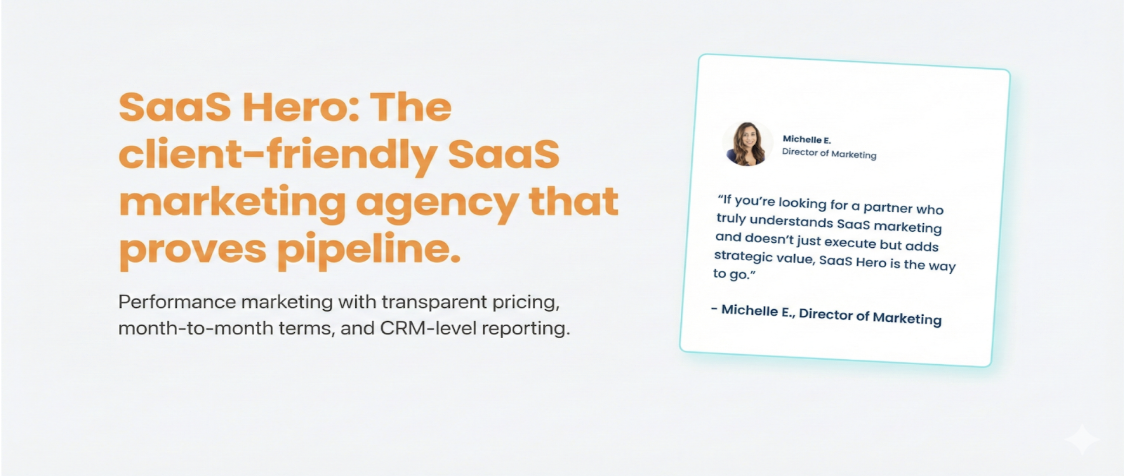
See how we connect ad spend to CRM pipeline in a 30-minute discovery call.
2026 Accountability Scorecard: How Leading Agencies Compare
The 2026 scorecard evaluates agencies on three structural criteria that determine whether a program can be held accountable to revenue: flat-fee pricing with no percentage-of-spend conflict, ownership of landing pages so the post-click experience sits in scope, and CRM attribution so optimization signals tie to pipeline instead of form fills. Agency inclusion reflects publicly documented scope and pricing as of 2026.
SaaSHero. SaaSHero uses a flat-fee retainer indexed to total ad spend, never per-channel or percentage-of-spend. The team designs, builds, hosts, and A/B tests landing pages in-house via Unbounce, treating the ad and landing page as a single conversion system. CRM attribution is standard. Lifecycle stage events flow back to ad platforms, and reporting runs through Looker Studio and HubSpot dashboards tied to pipeline and revenue.

Directive. Directive operates on a custom, scope-based retainer that is not publicly confirmed as flat across channel changes. The agency offers CRO services, although default ownership of landing page builds for paid media is not clearly documented. Directive connects every dollar of paid media spend directly to Salesforce and HubSpot data, which supports CRM-level attribution and revenue reporting.
KlientBoost. KlientBoost uses retainers that can include a percentage-of-spend component in some tiers based on public pricing. The agency explicitly treats the paid ad and landing page as a single conversion system and owns landing page work as part of that system. Conversion tracking is included, while CRM lifecycle optimization appears as a partial capability rather than a confirmed standard.
Understory Agency. Understory offers custom flat retainers per service and never charges a percentage-of-spend, according to its public pricing disclosures. Default ownership of landing pages for paid media engagements is not clearly confirmed. GTM engineering and related measurement work are available as a separate service line, which provides partial support for CRM-level attribution.
Principle 1: Align Incentives With Flat-Fee Pricing
Percentage-of-spend pricing puts a conflict at the center of the agency relationship. Percentage-of-ad-spend pricing typically charges 10% to 20% of monthly ad spend, which creates structural misalignment because agency revenue grows when the client spends more rather than when performance improves. Per-channel pricing introduces a second conflict of the same shape. Adding a channel raises the fee, so the recommendation and the invoice move together.
SaaSHero prices on a flat retainer indexed to total monthly ad spend, not channel count. Moving budget from LinkedIn to Google, opening a Meta test, or shutting a channel down entirely leaves the fee unchanged. Flat retainers are cleaner for SaaS companies, especially when paired with clearly defined deliverables and reporting cadences. The channel-mix recommendation becomes a purely empirical question when the invoice does not move with it.
Principle 2: Hit a 15–20 per Month Creative Testing Pace
Creative velocity describes the rate at which a team accumulates validated learning, not just ad output volume. The 2026 benchmark for B2B teams spending $10,000–$30,000 per month is 15–20 creative tests per month, with diminishing returns beginning at approximately 20–25 variants per month for most B2B audiences. Teams running 2–4 tests per month compound a durable CPL disadvantage over six months regardless of spend level.
The win rate on tested creatives stays low by design. Motion’s Creative Benchmarks 2026 analysis of 578,750 ads across 6,015 advertiser accounts found that only 3.8% of creatives become winners in micro spend tiers, rising to 8.2% in enterprise tiers. Volume becomes the mechanism for improvement rather than a nice-to-have. Winning creatives capture approximately 55% of total spend despite representing only about 6% of ads, which means the testing program is where budget efficiency is actually built.
SaaSHero runs creative end to end through a full-time in-house team that covers concept, copy, and design. New creative is developed continuously from campaign data instead of in occasional refresh projects. Freelance and contractor models for creative work require clients to handle strategy, briefs, timelines, feedback, and QA, which makes them poor fits for ongoing performance iteration or demand-gen workflows where learning compounds over time.
Talk to our creative team about running 15–20 tests per month against your ICP.
Principle 3: Treat Landing Pages as the Main Conversion Lever
The landing page is the highest-leverage variable in the paid acquisition chain, and it sits outside the scope of many agency retainers. An agency responsible only for the ad account cannot change the landing page headline, which SaaSHero data identifies as the most impactful lever for increasing landing page conversions, and cannot change what the CRM counts as qualified.
Most B2B tech teams take 10–19 days to move a new creative concept to live deployment, which fails to support rapid testing programs. Conversion rate multiplies every other improvement in the account. Cutting wasted spend creates a one-time gain. A higher landing page conversion rate changes the economics of every keyword and audience feeding it.
SaaSHero designs, builds, hosts, and A/B tests landing pages in-house using Figma for client approval and Unbounce for hosting and testing. The post-click experience stays in scope by default, not as a recommendation handed to the client web team. Headline testing runs first because the headline is the largest lever. The page ships without a third party.

Principle 4: Own Channel Mix Without Changing Fees
Channel-mix ownership often falls through the cracks at mid-market B2B SaaS companies. The incumbent agency scope covers only the channels it was hired to run, and per-channel pricing ensures that reallocation is the recommendation the pricing makes hardest to give. Performance-based pricing leads to attribution disputes and lead-quality gaming, as agencies gravitate toward easier wins rather than the client pipeline problems that matter.
SaaSHero manages across all major paid channels, including Google Ads, Microsoft Ads, LinkedIn, Meta, Reddit, and TikTok, and treats the mix itself as a deliverable. Because the retainer is indexed to total monthly ad spend rather than channel count, expanding into a new channel, consolidating two into one, or shutting down a channel that is not returning does not change fees and does not earn SaaSHero extra revenue. The recommendation and the invoice stay decoupled.
Principle 5: Separate Primary and Secondary Conversions
The conversion event an ad platform optimizes toward determines which audience it finds tomorrow. The attribution problems described earlier, where long buying cycles and multiple stakeholders make last-click measurement unreliable, explain why SaaSHero separates primary and secondary conversions in every account.
Secondary conversions such as content downloads, webinar registrations, and low-commitment form completions stay tracked and visible in reporting but never drive account-wide optimization. Primary conversions are CRM lifecycle stage events such as qualified opportunities, sales-accepted leads, and closed deals pushed back into the ad platforms so the algorithm learns from qualified outcomes. B2B SaaS teams that implement server-side tracking combined with CRM integration can send enriched conversion signals tied to actual closed revenue back to ad platforms, which allows algorithms to focus on higher-value customers and improve CAC and payback period outcomes over time.
The mandatory discovery question SaaSHero asks every prospect captures this principle in one sentence: “Are you optimizing campaigns around CRM data or just form submissions?”
Principle 6: Use 90-Day Validation Gates for Scale Decisions
A validation gate is a defined checkpoint, typically at day 90, when enough clean data exists to judge whether the channel, structure, and messaging thesis are sound before expanding spend. It functions as a measurement discipline, not a pricing mechanism. Growth-stage SaaS companies running hybrid demand generation models can grow revenue faster than companies running either pure in-house or pure outsourced models alone.
SaaSHero structures every engagement in phases. Phase 1 concentrates on the primary channel, usually paid search, and validates the conversion architecture, messaging thesis, and campaign structure before Phase 2 expands into demand creation on paid social. Running two channels from day one on an unvalidated conversion architecture prevents clean readouts. The gate moves forward, holds, or is skipped based on evidence alone, with no commercial conversation attached because channel count does not affect the fee.
Walk through our 90-day validation framework for your current spend level.
Implementation Roadmap for Revenue-Accountable Paid Media
The following steps apply regardless of which agency a $10M–$50M B2B SaaS company selects.
- Audit your current conversion architecture. Identify every conversion event currently used for account-wide optimization. Separate primary from secondary conversions. Determine whether any lifecycle stage events from your CRM are being pushed back to the ad platforms.
- Assess CRM data trust. Ask whether your team believes the pipeline figures in your CRM. If the ad platforms, GA4, and the CRM report three different numbers and nobody arbitrates, measurement infrastructure must be rebuilt before optimization can improve.
- Evaluate post-click ownership. Identify who owns the landing pages your paid campaigns point to. If the answer is a web team backlog or a contractor, you have created a structural problem because the highest-leverage variable in your funnel sits outside your agency scope and control.
- Confirm fee structure incentive alignment. Ask every agency under consideration whether their fee changes when you add, remove, or reweight a channel. If it does, the channel-mix recommendation carries an undisclosed financial interest.
- Set a 90-day validation gate before expanding spend. Define the metrics such as pipeline created, cost per SQL, and CAC payback trajectory that will determine whether Phase 2 expansion is warranted. Commit to the gate before launch.
- Establish board-ready reporting before the first campaign goes live. A CRM enables true customer acquisition analytics by linking every touchpoint to downstream pipeline and revenue, which is required for accurate CAC calculation. Build the dashboard before the spend, not after the quarter ends.
Before-and-After Examples From SaaSHero Clients
The following scenarios come from SaaSHero case studies and show the difference between optimizing to form fills and optimizing to CRM revenue outcomes.
Transit software company (TripMaster). Paid search produced traffic without a measurable line from ad spend to closed ARR. After SaaSHero rebuilt the conversion architecture and connected optimization to CRM outcomes, the account produced $504,758 in net new ARR over one year alongside a 20% conversion rate from paid search.

HR technology company (TestGorilla). Scaling paid acquisition after a $70M Series A required acquisition efficiency, not lead count. After optimization shifted toward CRM pipeline rather than form volume, the account reached an 80-day CAC payback period, which sits well inside the strong performance threshold mentioned earlier, while adding 5,000+ new customers.
CX software company (Playvox). Cost per lead had risen to the point that the channel economics no longer justified scaling. After restructuring campaign architecture and landing page testing, the account produced a 10x reduction in cost per lead alongside a 163% increase in lead volume.
Automotive software company (Shop Boss). Traffic converted at a rate that made the channel economics marginal. Landing page headline testing, the highest-leverage post-click variable, produced a 305% increase in conversion rate.
Discuss what revenue-accountable performance marketing would look like for your current spend and sales cycle.
Risks, Trade-Offs, and When Another Model Fits Better
Revenue-accountable performance marketing under a flat retainer does not fit every situation. Several trade-offs deserve attention.
Flat-fee retainers require defined scope. Flat monthly retainers risk scope drift if deliverables are undefined. Clients should confirm in writing which capability areas are included and which are not before signing.
CRM-level optimization requires CRM-level data hygiene. Pushing lifecycle stage events back to ad platforms stays only as accurate as the CRM data behind those events. Companies with inconsistent lead routing, undefined lifecycle stages, or untrustworthy pipeline data must fix the CRM before the optimization method can work.
The 90-day validation gate requires patience under board pressure. A program optimized toward qualified pipeline rather than form fills will often show a rising cost per lead in the first 30–60 days as the algorithm retrains. Marketing leaders must defend that trajectory to a board focused on lead volume before the pipeline data arrives.
In-house hires become right at sufficient scale and stability. Teams should consider bringing a function in-house once it reaches 30+ hours per week of consistent work; for paid media this threshold is typically reached around $50K-$100K per month in spend. At that threshold and with a stable channel mix, an in-house hire may be the correct structural decision.
Large integrated agencies fit multi-region mandates. Multi-region and multi-language delivery, offline and CTV media, and agency-of-record consolidation across every channel require capabilities a 20-person specialist firm cannot replicate. Companies with those requirements should evaluate integrated shops rather than specialist performance agencies.
Frequently Asked Questions
What does “optimizing to CRM data” actually mean in practice, and how is it different from standard conversion tracking?
Standard conversion tracking fires a signal to the ad platform when a user completes a page action such as submitting a form, clicking a button, or reaching a thank-you page. The platform then optimizes toward finding more people who repeat that action. CRM optimization replaces or supplements that page event with a downstream CRM record such as a lead that became a sales-qualified opportunity, a deal that moved to a specific lifecycle stage, or a contract that closed. The ad platform receives that signal, typically via offline conversion import or a CRM integration, and retrains its bidding model toward the audience profile associated with qualified outcomes rather than form completions. The practical difference shows up in which people the algorithm finds next month. An account trained on form fills finds form-fillers. An account trained on closed revenue finds buyers.
How long does it take to see pipeline results from a revenue-accountable paid media program?
The first 30 days focus on setup. Conversion tracking is rebuilt, campaign architecture is established, landing pages are designed and approved, and the first real data is collected. Days 31–60 narrow the account as underperformers are paused, audiences are adjusted, and landing page headline tests run. Day 90 becomes the first point at which enough clean data exists to evaluate channel economics rather than activity. Pipeline results depend on the client sales cycle length. A company with a 60-day average sales cycle will see closed revenue data inside the first engagement term. A company with a 180-day cycle will see pipeline created and opportunity progression, with closed revenue arriving in the following term. The 90-day validation gate is designed to answer whether the channel, structure, and messaging thesis are sound, not to produce a full CAC payback calculation.
Why does landing page ownership matter so much for performance marketing accountability?
Performance comes from the combination of traffic quality and post-click conversion rate. An agency that controls only the ad account can improve traffic quality but cannot change the page the traffic lands on. If the landing page headline makes a category claim instead of addressing the buyer problem, no amount of bid work compensates. As noted earlier, headline copy is the highest-leverage variable for conversion rate, which makes agency control of landing pages non-negotiable for revenue accountability. An agency that cannot change the headline cannot be held accountable for conversion rate, cost per qualified lead, or pipeline. Ownership of the post-click experience forms a prerequisite for revenue accountability, not an add-on service.
What should a VP of Marketing ask an agency to determine whether it is truly revenue-accountable?
Four questions surface the accountability gap quickly. First, ask which conversion event is currently used for account-wide optimization and whether it is a page event or a CRM record. Second, ask who owns the landing pages the campaigns point to and when the last headline test ran. Third, ask whether the fee changes if you add a channel, remove a channel, or move budget between channels. Fourth, ask what the monthly report leads with, platform metrics or pipeline and CAC. An agency that answers the first question with “form submissions,” the second with “your web team,” the third with “yes,” and the fourth with “impressions and clicks” is optimizing to the wrong signal, stopping at the click, pricing in a way that discourages reallocation, and reporting in a language the board does not use.
Is a flat-fee retainer always better than performance-based pricing for B2B SaaS?
Flat-fee retainers do not always win by default. Performance-based pricing appears accountable on paper, but in long B2B sales cycles it creates attribution disputes and lead-quality gaming. Agencies using performance-based models price in risk premiums and gravitate toward the conversion actions easiest to influence, typically top-of-funnel form fills, rather than the pipeline outcomes the client actually needs. The deeper problem is that performance-based pricing requires agreement on attribution methodology before the engagement starts, and that agreement rarely stays durable across a six-to-nine-month sales cycle with a buying committee. Flat-fee retainers with clearly defined deliverables and CRM-connected reporting cadences avoid both the attribution dispute and the gaming incentive while keeping the agency recommendation independent of its revenue.
Conclusion: Moving From Clicks to Revenue Accountability
The accountability gap in B2B SaaS performance marketing is structural, not personal. Platform automation moved the work to data quality. Broken measurement moved the answer into the CRM. Mid-market teams hold the judgment but not the operators. The standard retainer stops short of the chain it is judged on and is priced in a way that discourages widening it.
The six principles in this scorecard, flat-fee incentive alignment, creative velocity at 15–20 tests per month, landing-page testing as a default scope item, channel-mix ownership without fee impact, primary-versus-secondary conversion architecture, and 90-day validation gates, define what a revenue-accountable performance marketing agency must own. SaaSHero meets all six principles under a single flat retainer, with in-house creative, in-house landing page design and testing, and CRM attribution as standard rather than optional.
The internal audit starts with one question: are you optimizing campaigns around CRM data or just form submissions? If the answer is form submissions, the program is training the ad platform toward the wrong audience, and the board meeting at the end of the quarter will show it.
Book a revenue accountability review with SaaSHero to audit your current conversion architecture and see what your paid program is actually optimizing toward.